

Frame of Mind: Class Dismissed; the Bay is Yours
A Future Collision DisruptHER’s Guide to Owning the Shop Floor Without Shrinking, Spiraling or Setting Anything Expensive on Fire
By Jannifer Stimmel-Watkins, Technical Editor

Glossed & Gritty’s Technical Editor draws on her years of experience as a collision repair instructor in her “New Grad” series, dedicated to helping the newest generation of DisruptHERs navigate the “real world” hurdles that a syllabus can’t prepare you for!
Stepping out of the classroom and into the collision industry can feel like being handed a repair order written in another language while everyone pretends you should already know where every tool lives. In this Frame of Mind editorial, Jannifer Stimmel-Watkins speaks directly to the newest generation of Collision DisruptHERs, especially the students and entry-level technicians preparing to leave training behind and claim their place in the bay. Drawing from her experience as a former collision repair instructor, Jannifer breaks down what young women actually need to hear before they enter the shop: that mistakes are not identity flaws, confidence…

Whether you’re currently tossing a graduation cap, transitioning from a part-time apprenticeship to a full-time stall or standing on the outside looking in – wondering if you have the grit to trade a traditional desk for a frame rack – welcome to the launchpad. The collision industry is often misunderstood as a dead-end road paved with repetitive tasks, busted knuckles and suspicious vending machine lunches…but for the modern Collision DisruptHER, this trade is not some dusty backup plan. It’s a high-tech frontier of physics, chemistry, craftsmanship, digital diagnostics and the very specific ability to remain calm while a dashboard lights up like it is auditioning for a casino residency.
Stepping into a live production facility for the first time is a full-body, adrenaline-fueled culture shock. The noise is louder, the pace is faster, expectations are higher, and the coffee is usually suspect. But this is where everything also starts to get real. And that requires a shift in mindset from being a student of the trade to being a strategist of your own career. You are not simply looking for a paycheck; you are auditing shops, vetting mentors, studying work cultures and deciding where to invest your unique technical talents before some poorly managed shop tries to convince you that “paying your dues” means tolerating BS in fluorescent lighting.
From the refined artistry of the paint booth to the surgical precision of ADAS calibrations, the path you choose today defines the legacy you build tomorrow. (Explore just a few of the possibilities by checking out my recent message in Impact Report or The Riveter, the monthly e-newsletters from Glossed & Gritty.
Now take a breath, square your shoulders, and understand this clearly: You are not entering collision repair to quietly take up space, you are here to own your bay!
From “Hot Mess” to Mastery: Navigating the Learning Curve
To every graduate stepping onto a commercial shop floor for the first time this year: I need you to brace yourself for an emotional reality check. No matter how strong your technical school program was, no matter how many perfect lab scores you earned, no matter how many times your instructor said, “Nice weld”…
Your first six months in a live production shop will likely humble you to the same extent as that random day you got your period after deciding to wear white/light colored shorts – and of course you were in front of a ton of people while desperately trying to find an exit strategy. You know exactly what I’m talking about!
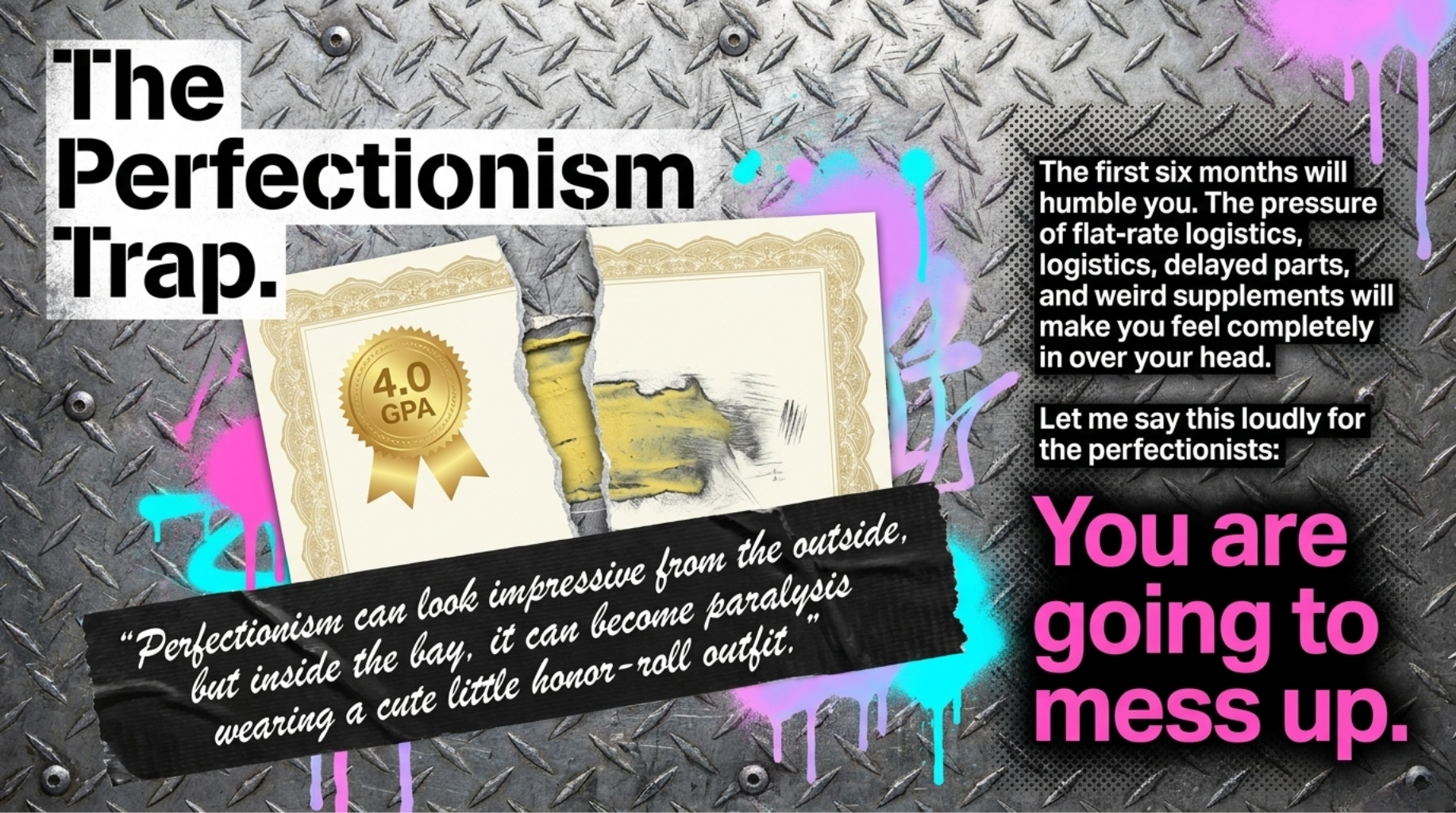
The speed, the noise, the pressure of flat-rate logistics and the sheer volume of different vehicle makes and models will create moments where you feel completely in over your head. Parts are delayed, supplements are weird, clips are hidden, and the deadlines are real. At least once, you will stare at something and think, “I have no idea what this thing wants from me” while cursing the engineer who designed that part.
Congratulations – you are learning!
You will make mistakes. Let me say that louder for the perfectionists like me in the back, clutching their 4.0 GPA like a sacred document: You are going to mess up.
You might sand off that styleline you worked so hard to preserve and burn through clear right before delivery, causing the painter’s soul to briefly leave his body. You may mix a body filler ratio wrong, resulting in a substance that has the structural consistency of soft cream cheese. You could break an expensive interior trim panel because some engineer hid a clip behind three layers of plastic, two lies and a blood oath. You might misread a procedure, grab the wrong grit, forget a step, overthink a task, underthink a task or spend twenty minutes looking for a tool that is somehow in your own hand.
When these moments happen, self-doubt will hit – hard. You may feel like a total hot mess. Good! Not because mistakes are fun; they are not. They are annoying little gremlins with invoices attached. But mistakes are part of the learning curve.
They are not proof that you don’t belong. Many young female technicians fall into the trap of internalizing these technical errors as validation of their worst fears, of seeing them as evidence that the old-school skeptics were right about them, as a neon sign from the universe saying, “Exit trade now and never return.”
That is absolute bullshit!
Every single master technician you admire started as a beginner who made mistakes – the guys with fifty thousand dollars worth of tools who can turn eighty flat-rate hours a week without blinking did not emerge from the womb holding a DA sander and a perfect repair plan. They started out as a total hot mess.
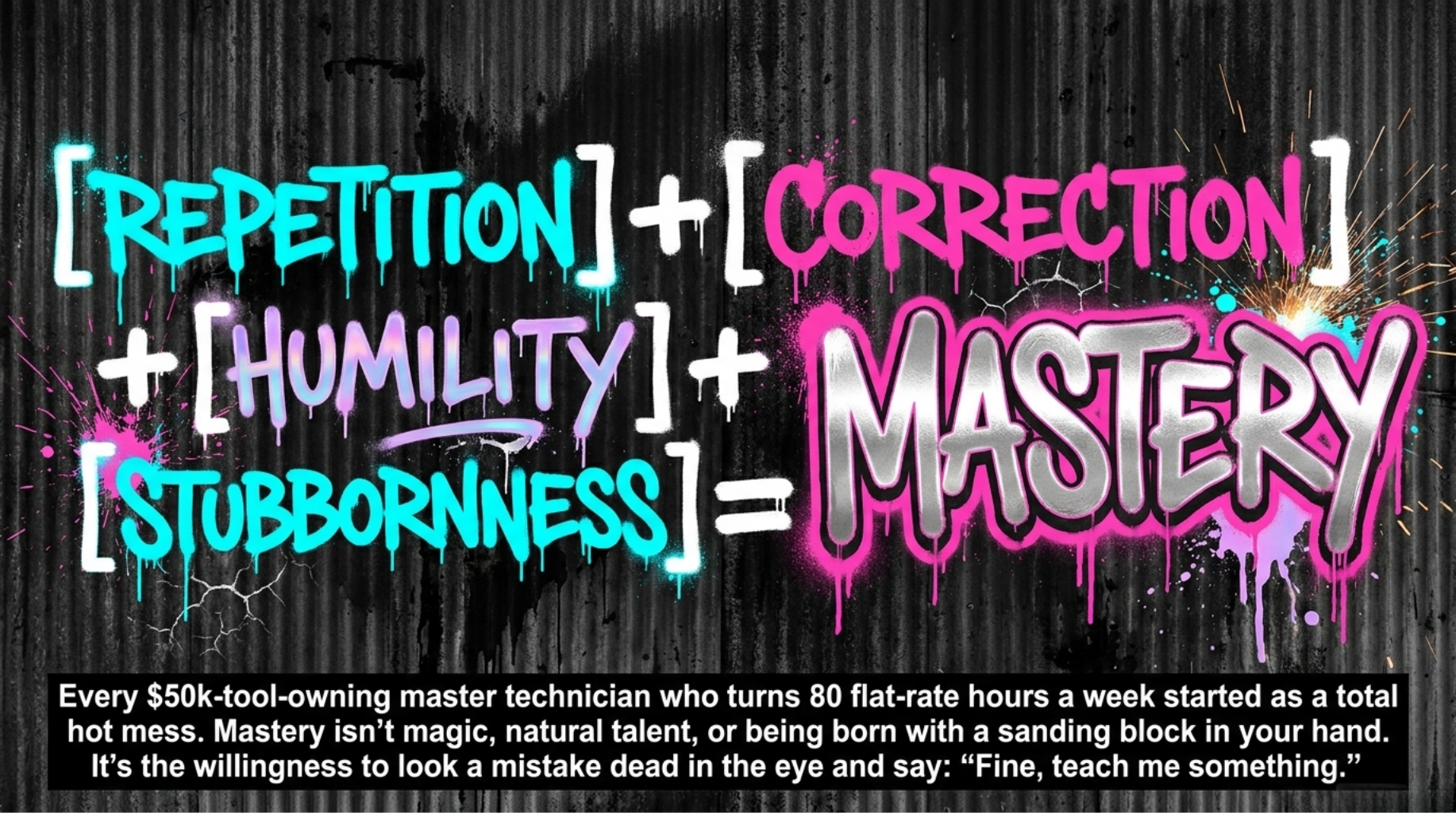
They have all warped panels, broken parts, ruined expensive paint jobs, misdiagnosed electrical failures, sanded too far, used the wrong clip, forgot something important and lived through days where their confidence was held together with caffeine and sheer stubbornness.
The difference between a master and someone who quits is not the absence of failures; it’s how they process those failures, whether they learn from it and how they choose to proceed.
When a mistake happens – and again, it will! – do not spiral. Do not hide it or pretend the broken clip was “already like that.” The shop gods see all, and they are petty little trolls – take a deep breath and follow what I like to call “the technical error protocol:”
- Step 1: Own the mistake immediately. Do not hide a broken clip or an edge burn.
- Step 2: Cleanly assess the failure. Figure out exactly why the material or metal reacted the way it did. Determine what caused the problem. Was it angle, speed, temperature, material selection, pressure, procedure, timing or plain old rushing?
- Step 3: Ask for technical input. Find a lead technician, mentor, instructor or trusted teammate, and ask how to correct it.
- Step 4: Fix it and adjust. Execute the correction, change the technique, and log the lesson into your brain under “expensive but useful.”
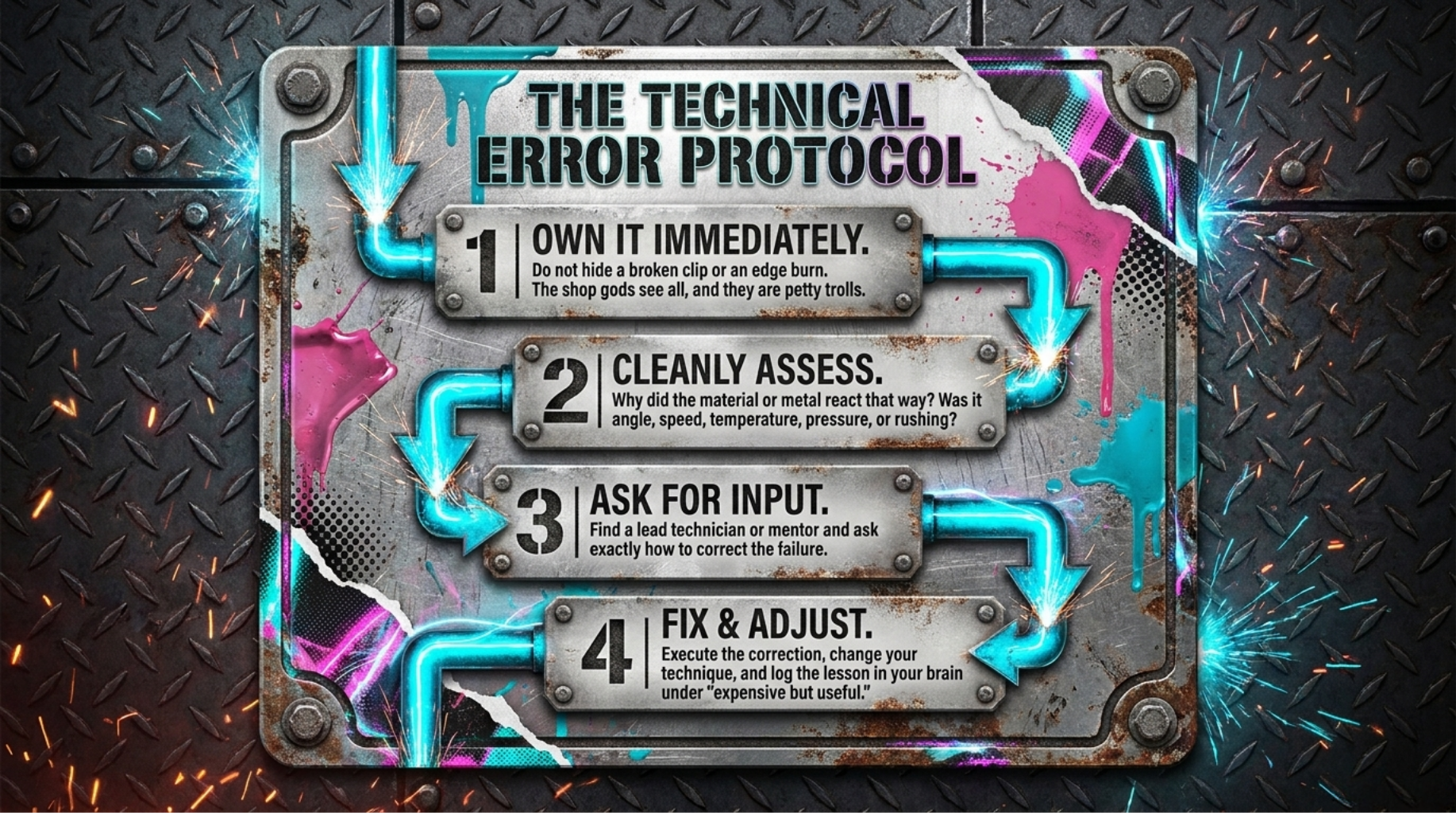
Treat every error as a neutral, technical calibration. A bad weld, a run in the clear or a failed calibration isn’t a reflection of your worth or your intelligence; it is simply raw data. Annoying data, yes, but still data. Your angle, your speed or your process needs adjustment – not your identity. Own the mistake immediately, ask an experienced tech for a tip on how to resolve it, clean up your workspace, and “Carry on my wayward son hun”. (Look, adjustment was needed there, and I’m southern, so problem solved.)
My advanced collision instructor was a total boy-genius who apparently made it his sacred, daily vow to tease me relentlessly throughout my courses. I am a proudly neurotic perfectionist, a trait that secured me straight A’s across the entire program – until his class in the final semester handed me my first, soul-crushing B.
Naturally, I was calm, mature and completely reasonable about it. Okay, okay (in my best Maury Povich voice): “That was a lie.” Perplexed, deeply offended and spiritually inconvenienced, I went to him for an explanation. I was fully prepared to present my case like a tiny academic attorney with body filler dust on her boots. Instead, he dropped a piece of wisdom on me that permanently rewired my brain (and if he ever sees this, I will deny saying it because his head is already overinflated):
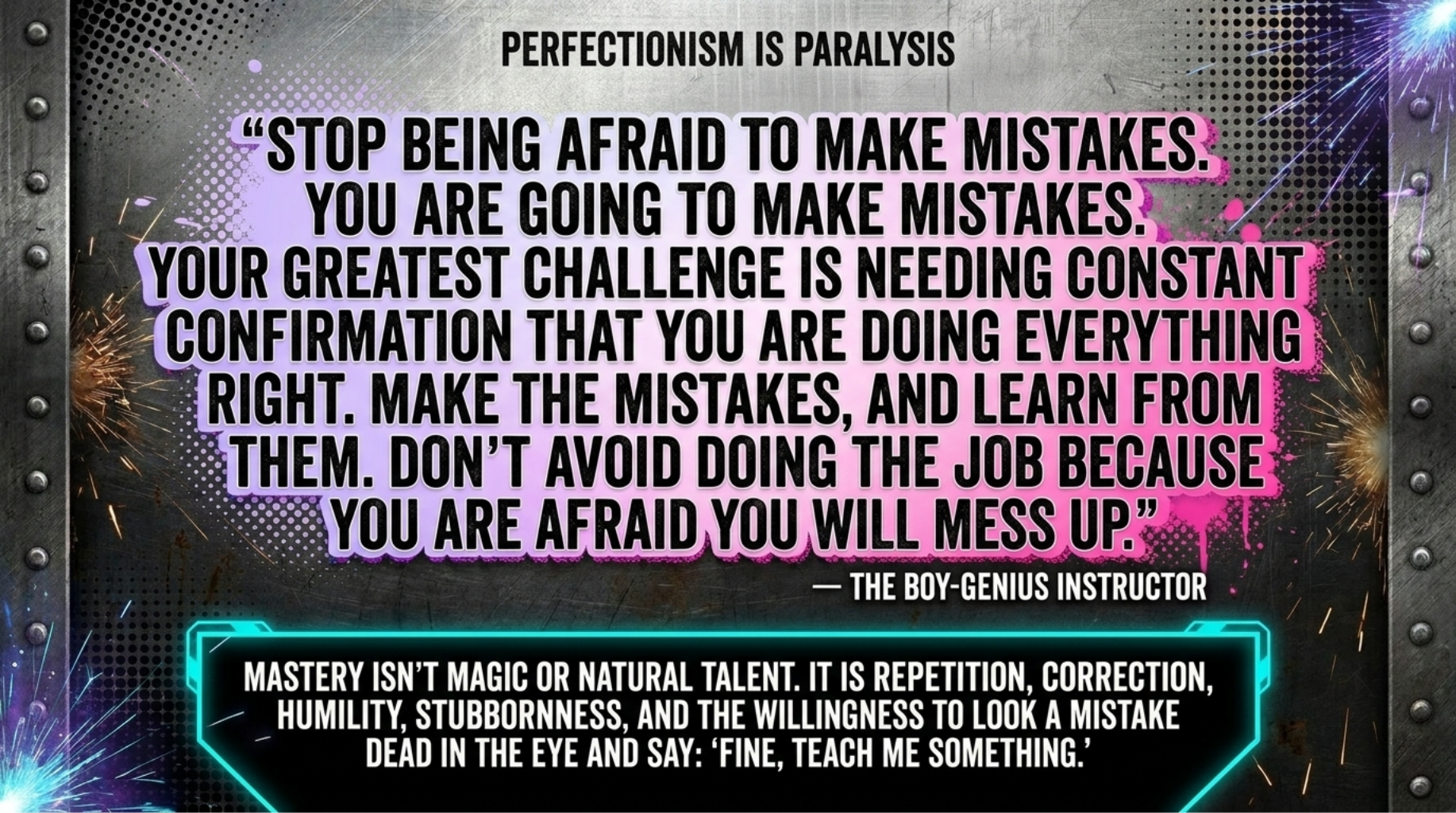
“Stop being afraid to make mistakes. You are going to make mistakes. Your greatest challenge is that you need constant confirmation that you are doing everything right, but there is not a perfect answer for everything. Make the mistakes, and learn from them. Don’t avoid doing the job because you are afraid you will mess up.”
Rude! Accurate, unfortunately…and dare I say, one of the best pieces of advice I ever received. Perfectionism can look impressive from the outside, but inside the bay, it can become paralysis wearing a cute little honor-roll outfit. You cannot become skilled by avoiding the work that might expose your weak spots. You become skilled by doing the work, finding the weak spots, correcting them and showing up again. That is mastery. It’s not magic or natural talent. It’s not even being born with a sanding block in your hand. Mastery is repetition, correction, humility, stubbornness and the willingness to look a mistake dead in the eye and say – perhaps through those clenched teeth – “Fine, teach me something.”
Commanding the Shop Floor Without Shrinking Yourself
The collision industry requires physical grit, but your mental focus is what will ultimately define your longevity. Working in a male-dominated trade means you will inevitably encounter outdated mindsets still lingering around the shop like bad primer fumes. You might walk into a shop where people use patronizing language or quietly watch you from a distance like you’re the subject of an exotic wildlife documentary, waiting to see if you will fail under pressure. Let them wait! You have work to do.
Hear me clearly: YOU do not need to shrink to fit into their outdated molds.
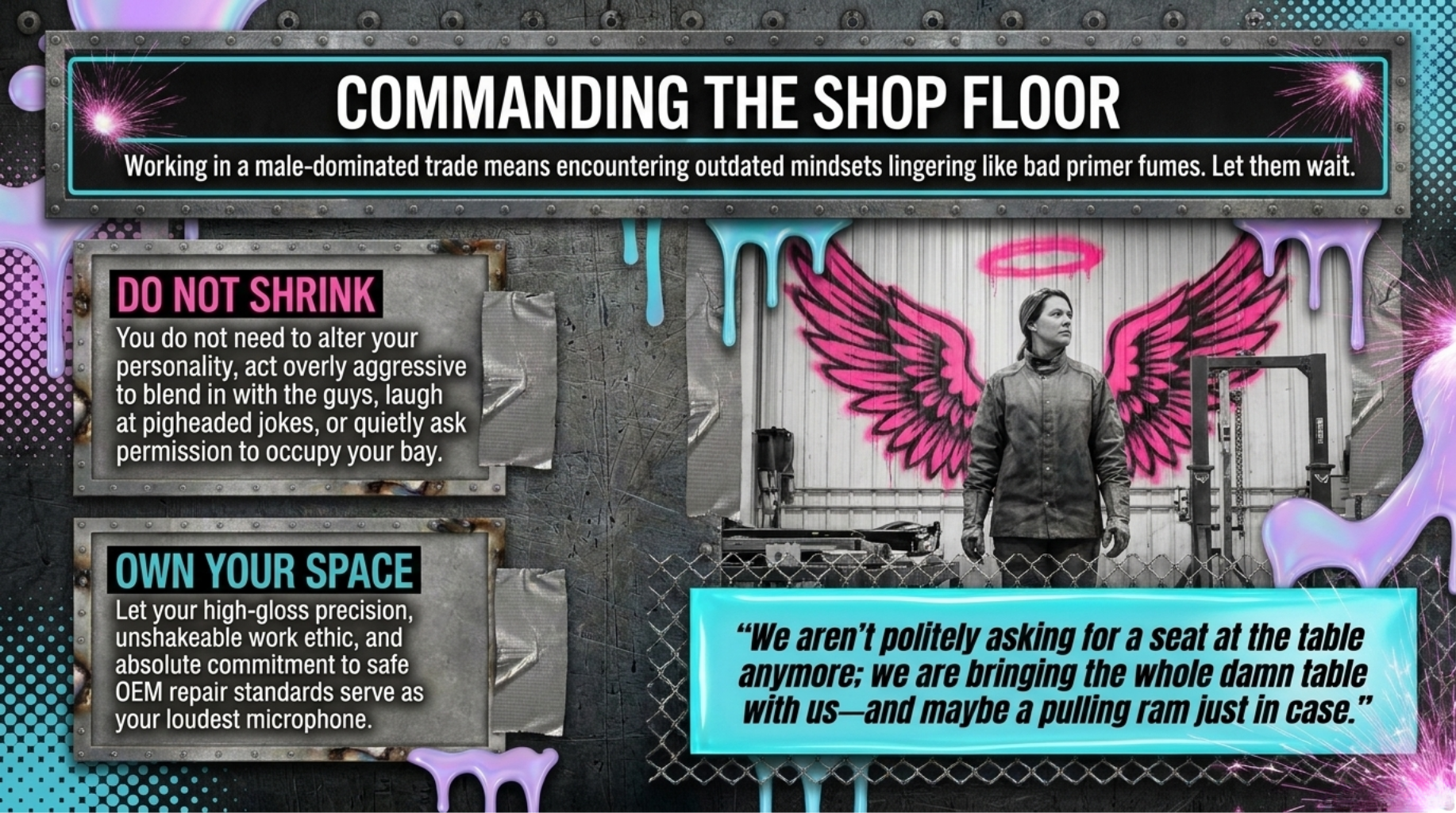
You do not need to alter your personality, act overly aggressive to blend in with “the guys,” laugh at every lazy, pigheaded joke or quietly ask permission to occupy your bay. You have invested your time, your money, your focus and your intellectual energy into gaining an education. You are trained, you are qualified, and you hold the credentials. You aren’t stepping onto that shop floor to blend into the background like beige wallpaper with safety shoes. We aren’t politely asking for a seat at the table anymore; we are bringing the whole damn table with us – and maybe a pulling ram just in case.
Let your high-gloss precision, your unshakeable work ethic, your repair knowledge and your absolute commitment to safe, proper OEM repair standards serve as your loudest microphone. When you produce clean, efficient work where your procedures are researched, your documentation is solid and it passes every quality-control check, you control the narrative. I’m going to be honest with you – not everyone will love that. It’s tragic, but proceed anyway, grasshopper. Any time I’ve come into contact with that kind of outdated prejudice, a cocky smirk spreads across my face with the same muscle memory I use when blocking a panel. I try to restrain it. Truly, I do. Restraint has never been one of my natural strengths. So with a wink and just enough sweetness to make it sting, I usually let one phrase roll out: “My dear, if you don’t like what’s going on in front, you can always kiss the back.”

Simultaneously, you must protect your physical and mental well-being from day one like it is part of your toolbox. Do not let old-school, careless habits or shop peer pressure convince you to cut corners on safety. If the older technicians around you refuse to wear their respirators while spraying primer, let them enjoy whatever personal relationship they are building with lung damage. (Remember: Some of them come from an era when they were spraying with one hand, while puffing on a Pall Mall with the other.) Continue to wear yours anyway.
If they skip safety glasses when running a cut-off wheel because they think sparks build character, protect your eyes anyway – having matching eyeballs is a great look. Use proper lifting mechanics when moving heavy bumper assemblies, grill guards or core supports, doors, hoods and anything else that looks manageable right before it disrespects and wrecks your spine.
Your body is the literal instrument of your trade; treating it with respect is a sign of true professionalism, not weakness.
Daily Legacy Protections
- Physical: Dual-cartridge respirator, ANSI Z87.1 safety glasses, hearing protection, ergonomic lifting. Stretch, hydrate and stop acting like your knees are renewable resources.
- Mental: Disconnect from shop gossip; focus entirely on stall efficiency, technical growth and becoming too good to ignore!
- Community: Stay connected to women who understand this trade, this pressure and this particular brand of shop-floor chaos. (What a coincidence that you can find a whole batch of these badass women in the Collision DisruptHER community!)
Build a solid circle of support outside of your immediate workspace early. Stay in touch with your tech school instructors, reach out to former classmates who are navigating their own apprenticeships, and plug into professional communities of female technicians already working in the industry who understand the unique triumphs and challenges of the shop. Ask questions, share wins, vent when needed…and believe me hunnie, you will need it. Celebrate progress that nobody outside the trade understands. Trust me, I have seen the glazed over eyes the second that anything collision-related stumbles from my mouth.
Community matters. Because some days, you will need someone who knows exactly why a broken tab can send you into a tiny emotional weather event. Having a community to lean on keeps you anchored when the shop gets loud, the learning curve gets steep and isolation tries to convince you that you are the only one figuring it out as you go. You are not.
To the graduating class and the rising seniors standing at the edge of this incredible trade: look in the mirror and recognize the power you carry. You are not just entering a workforce; you are mobilizing a revolution in repair. The modern collision repair landscape desperately needs your intelligence, your focus, your patience, your curiosity, your dedication to safety and your unmatched eye for detail.
It is completely okay to love the artistic elegance of a flawless paint finish while simultaneously wielding the raw industrial strength needed to pull a frame rail back into alignment. It’s okay to understand color theory and structural integrity. It is even okay to be soft-spoken and technically lethal. It is okay to be Glossed and Gritty!
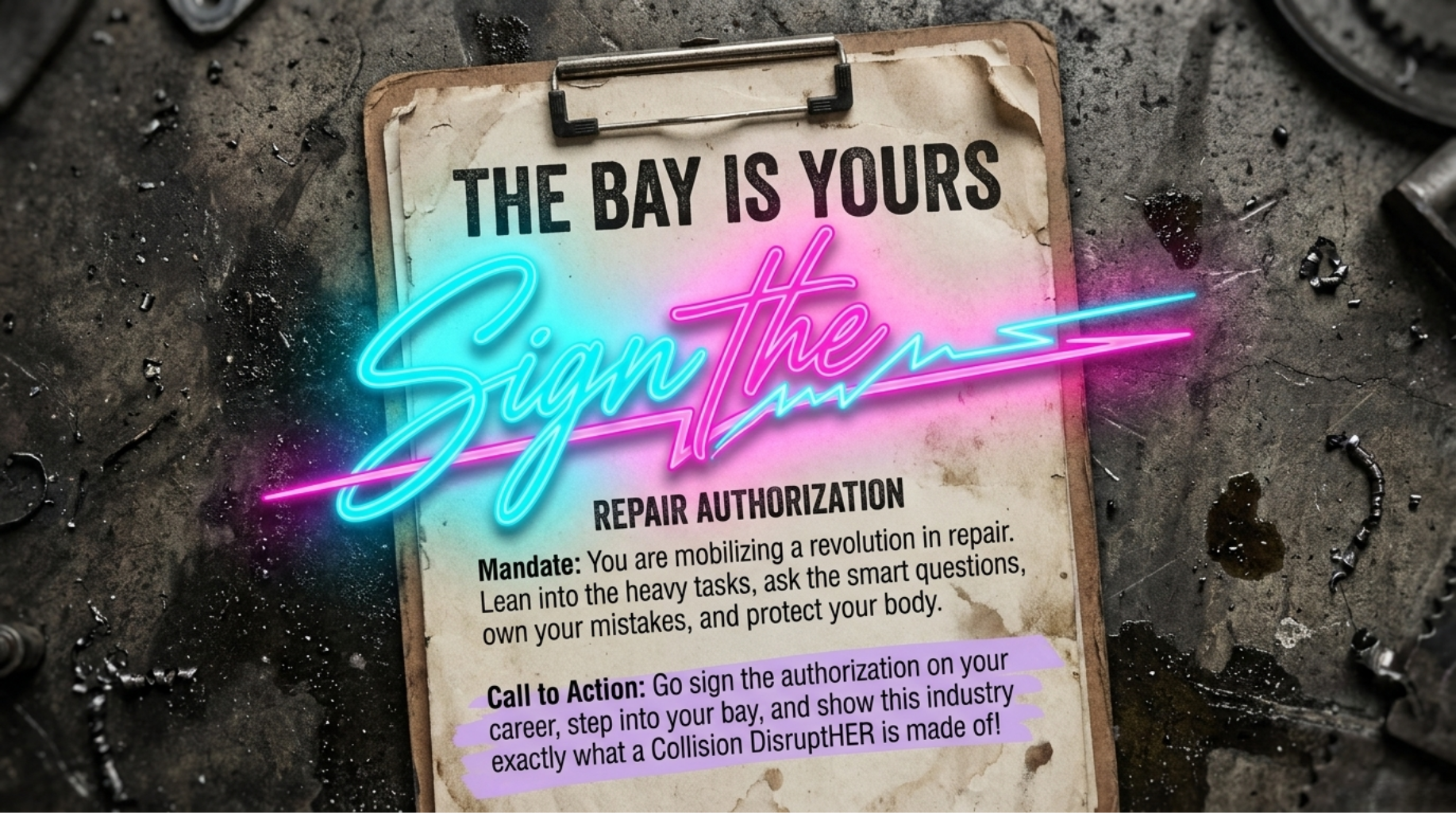
Take a deep, steady breath as you step out onto that shop floor for your very first full-time shift. Let the noise hit, let the pressure exist, and let the learning curve do what it came to do. Then get to work. Lean into the heavy tasks, ask the smart questions, research the procedures, own your mistakes, protect your body, build your community, and enjoy the absolute thrill of fixing complex machines with your own two hands. And never let anyone convince you that you don’t belong. Last but definitely not least, stop apologizing for taking up space in an industry that needs exactly what you bring.
You are entering a workforce that is being rebuilt by your intelligence and your hands. Lean into the experience, embrace the “hot mess” moments as the technical data they are, and never, ever shrink yourself to fit into a shop culture that hasn’t caught up to your caliber.
Go sign the authorization on your career, step into your bay, and show this industry exactly what a Collision DisruptHER is made of!
Want to dive deeper into not only surviving but navigating your first year on the shop floor, negotiating your first tool allowance, handling complex shop culture, building confidence after mistakes, and figuring out which career lane actually fits you? This installment is just a portion of the blueprint in your career-building kit. We are sticking with the newcomers for the long haul this summer because a strong career needs more than enthusiasm to ensure your foundation is built from structural-grade steel. Stay tuned, DisruptHER, the bay is just getting gritty.