

Gear & Glam: Pack Smart. Walk Far. Regret Less
By: Jannifer Stimmel-Watkins

Like the clear we lay, this Gloss has coats. You've only just begun to scuff the surface!
Already a member? Log in and keep reading.
Not in yet? Become a free member of the Collision DisruptHERs Community to unlock the next coat of Glossed access: more story, more context, and the parts we don't leave sitting on the surface.
Want the full article, complete issues, Impact Report, archives, and subscriber-only extras? That's the Gritty.
Like the clear we lay, this Gloss has coats. You've only just begun to scuff the surface!
Already a member? Log in and keep reading.
Not in yet? Become a free member of the Collision DisruptHERs Community to unlock the next coat of Glossed access: more story, more context, and the parts we don't leave sitting on the surface.
Want the full article, complete issues, Impact Report, archives, and subscriber-only extras? That's the Gritty.
By: Jannifer Stimmel-Watkins
The most valuable thing you bring home from an industry event may be a new connection, renewed confidence or the reminder that you are not navigating this career alone. Collision professionals share how networking, preparation and intentional rest make conferences more useful and less overwhelming. Learn how to protect your energy, plan your priorities and return home with fresh momentum—not merely the heaviest tote bag on the show floor.
Like the clear we lay, this Gloss has coats. You've only just begun to scuff the surface!
Already a member? Log in and keep reading.
Not in yet? Become a free member of the Collision DisruptHERs Community to unlock the next coat of Glossed access: more story, more context, and the parts we don't leave sitting on the surface.
Want the full article, complete issues, Impact Report, archives, and subscriber-only extras? That's the Gritty.
This section is reserved for Subscribers.
The Q&A portion is one of the many benefits of The Gritty subscriber experience.
Grab a subscription for as low as $8.99 mo., to find out how she responded and unlock subscriber-only features such as: full access to issues (Digital w/Surface Tension Level) or Digital + Print (High Gloss Level or Above), archives, premium guides, roundtables, and the full Gritty behind the bay door. Subscriptions start at ONLY $8.99 mo.

The Collision DisruptHER’s Guide to SPF, Sparks and Skin Survival
By: Jannifer Stimmel-Watkins
Collision repair is brutal on skin, and pretending otherwise is how you end up looking like the shop won custody of your face. In this Recalibration: Mind & Body article, Jannifer Stimmel-Watkins takes on the grime, UV exposure, fiberglass itch, cracked hands, mystery chemicals, welding light, sanding dust, and general shop-floor nonsense that Collision DisruptHERs deal with every day. The point is not vanity. It is protection. This article reframes skincare as maintenance, because that is exactly what it is. Technicians are trained to protect panels, prep surfaces, apply coatings, prevent corrosion, and avoid contamination, yet too many are expected…

Collision repair is not exactly a spa day with better lighting! Between sanding dust, solvents, primer, sweat, welding sparks, adhesive residue, respirator lines, nitrile gloves, fiberglass particles, metal shavings, mystery shop grime and whatever sticky substance is on the door handle that nobody wants to investigate, your skin goes through a full obstacle course before lunch. And somehow, skincare in this industry still gets treated like a luxury – as if it’s something soft and extra or designed for people who do not spend their day crawling around bumper covers or trying to remove a hidden clip designed by a goblin with an engineering degree.
Like the clear we lay, this Gloss has coats. You've only just begun to scuff the surface!
Already a member? Log in and keep reading.
Not in yet? Become a free member of the Collision DisruptHERs Community to unlock the next coat of Glossed access: more story, more context, and the parts we don't leave sitting on the surface.
Want the full article, complete issues, Impact Report, archives, and subscriber-only extras? That's the Gritty.
Unleashing the Future
Welcome to the shop floor. Wipe your boots, grab a grinder, and leave your fragile ego at the door.
Current Issue
Cover:

-

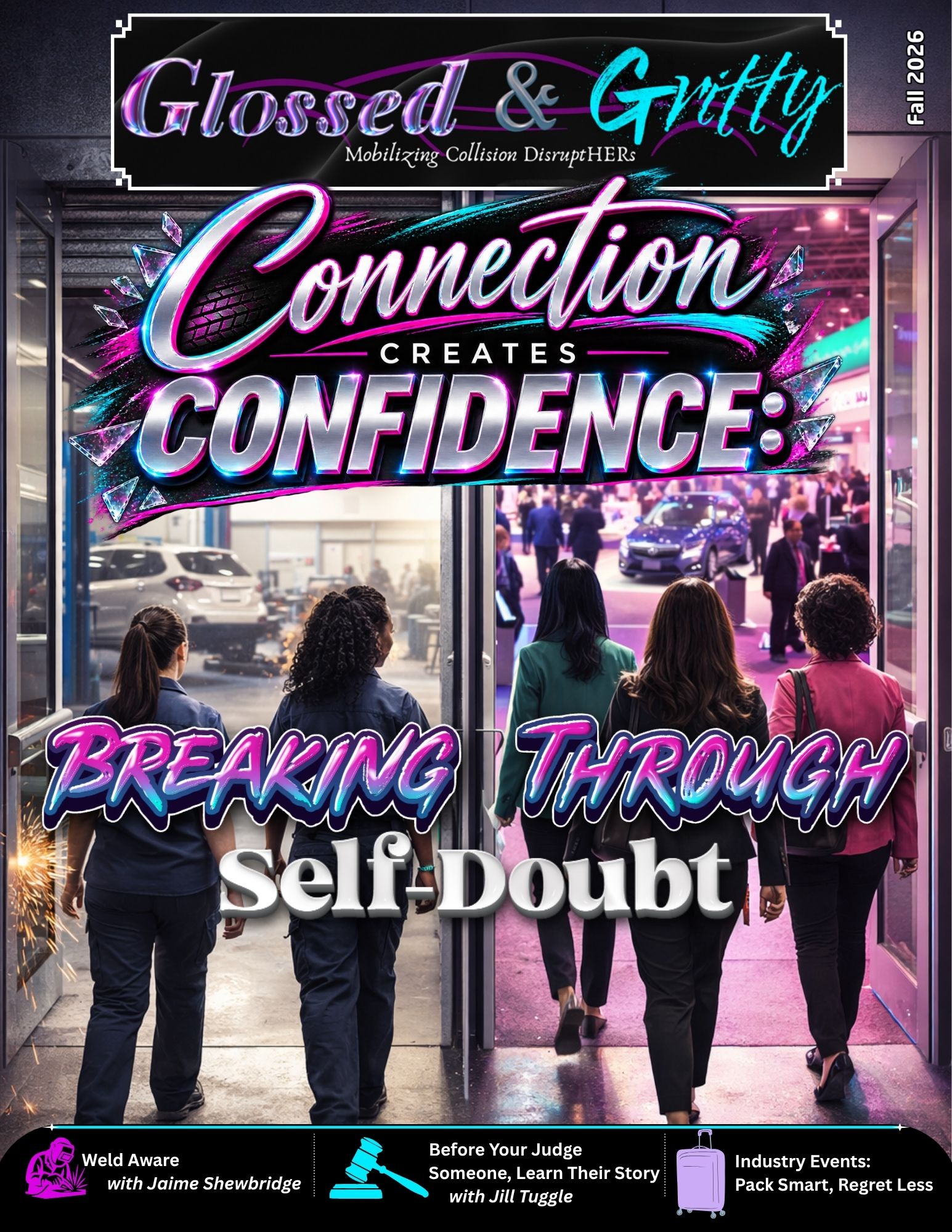
On the Cover: Connection Creates Confidence
Women are constantly told to be more confident—but confidence rarely appears because someone ordered us to find some. This cover story digs into the confidence gap, psychological safety and the environments that determine whether talented women speak up or shrink back. Through research and real collision-industry experiences, discover why belonging often comes before confidence—and how one introduction, mentor or open…
-
Issue 3: Welcome Back, Collision DisruptHER!
A new season brings fresh notebooks, new challenges and that familiar combination of “I’ve got this” and “What the hell am I doing?” Issue 3 is your permission slip to begin before you feel ready. Every expert was once new, every confident leader had a first day and every DisruptHER started somewhere. You do not have to be fearless or have everything figured out. You simply have to take the next step.

Notes from The Editors:

Frame of Mind: Class Is in Session… So Is Your Reputation
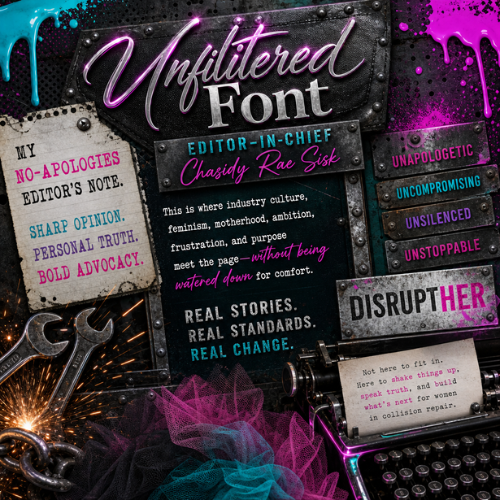
Unfiltered Font: A Whole New Family
Featured DisruptHERs
-
Dynasty DisruptHER: Micki Woods
Marketing may attract attention, but Micki Woods knows it cannot rescue weak leadership, unhealthy culture or broken trust. After owning a shop, surviving the 2008 recession and sitting in the chair where payroll becomes personal, Micki built a career helping collision businesses become stronger from the inside out. She shares the hard-earned lessons behind her people-first approach—and why the healthiest, most resilient businesses are built around relationships rather than transactions.

-
Polished DisruptHER: Jill Tuggle
Jill Tuggle’s career changed every time someone convinced her to “hear me out.” From delivering wheels to leading the Auto Body Association of Texas, her unconventional path proves that leadership does not require knowing everything—it requires curiosity, collaboration and the confidence to ask the right people. Jill opens up about loss, faith, imposter syndrome, advocacy…

-
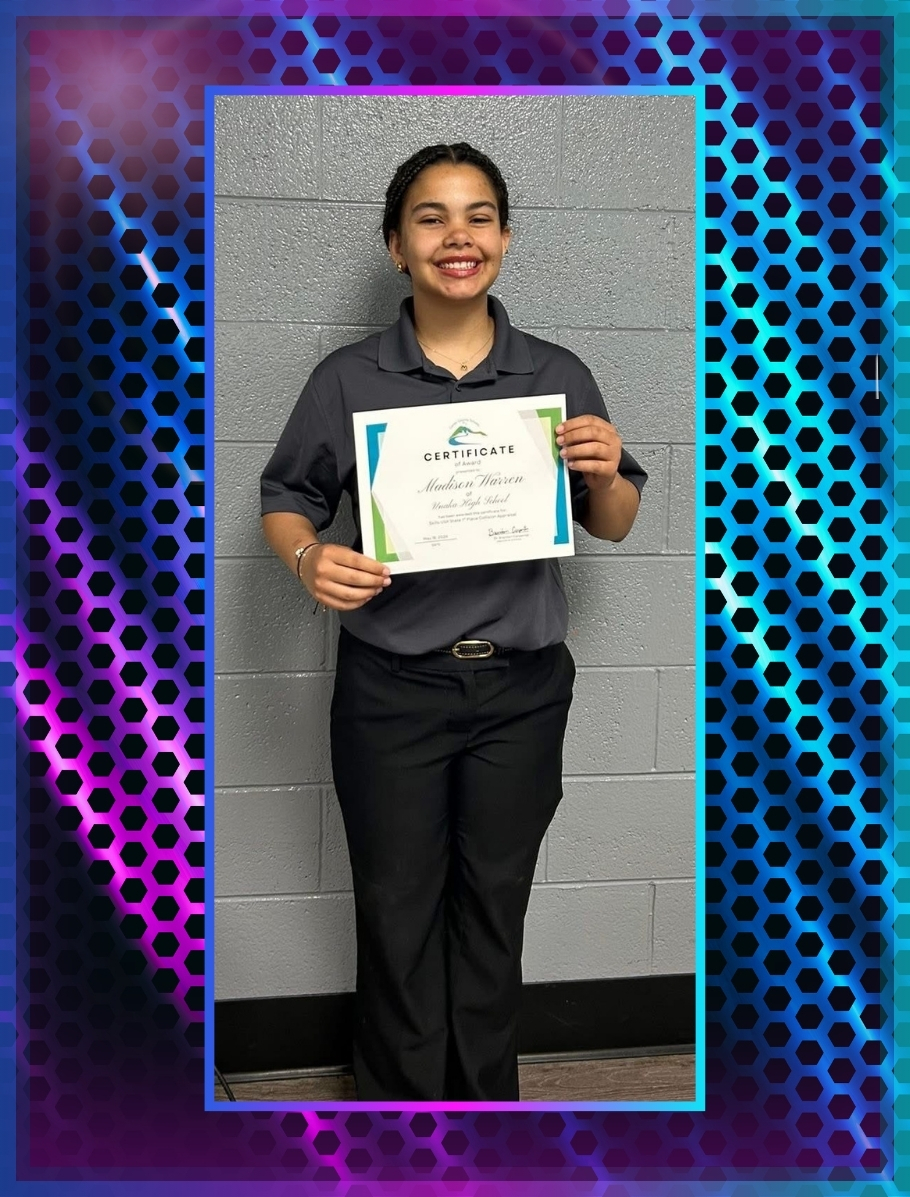
Primed DisruptHER: Madison Warren
At 18, Madison Warren is already a Toyota- and Lexus-certified estimator, a national SkillsUSA champion and a young professional determined to raise the standard of collision repair. Her path from shy freshman to skilled repair planner was built through mentorship, preparation and one lesson she refused to forget: trust the process. Madison shares how OEM procedures, customer advocacy and one disappointing competition finish became pieces of a…
In Her Words:
-
In Her Words: Before You Judge Someone, Learn Their Story
After more than a decade volunteering with women affected by sexual exploitation, Jill Tuggle has learned how rarely assumptions resemble reality. She challenges us to look beyond someone’s behavior, circumstances or mistakes and get curious about the story underneath. From strip-club outreach to collision-shop culture, Jill explores dignity, accountability and the difference between excusing harmful…
Featured Anchor:
Glossed & Gritty Article Sections:
Newsletters: The Riveter (Member) & Impact Report
-
July E-News 2026
Frame of Mind: Class Dismissed; the Bay is Yours
A Future Collision DisruptHER’s Guide to Owning the Shop Floor Without Shrinking, Spiraling or Setting Anything Expensive on Fire
By Jannifer Stimmel-Watkins, Technical Editor
Glossed & Gritty’s Technical Editor draws on her years of experience as a collision repair instructor in her “New Grad” series, dedicated to helping the newest generation of DisruptHERs navigate the “real world” hurdles that a syllabus can’t prepare you for!
Stepping out of the classroom and into the collision industry can feel like being handed a repair order written in another language while everyone pretends you should already know where every tool lives. In this Frame of Mind editorial, Jannifer Stimmel-Watkins speaks directly to the newest generation of Collision DisruptHERs, especially the students and entry-level technicians preparing to leave training behind and claim their place in the bay. Drawing from her experience as a former collision repair instructor, Jannifer breaks down what young women actually need to hear before they enter the shop: that mistakes are not identity flaws, confidence…

Whether you’re currently tossing a graduation cap, transitioning from a part-time apprenticeship to a full-time stall or standing on the outside looking in – wondering if you have the grit to trade a traditional desk for a frame rack – welcome to the launchpad. The collision industry is often misunderstood as a dead-end road paved with repetitive tasks, busted knuckles and suspicious vending machine lunches…but for the modern Collision DisruptHER, this trade is not some dusty backup plan. It’s a high-tech frontier of physics, chemistry, craftsmanship, digital diagnostics and the very specific ability to remain calm while a dashboard lights up like it is auditioning for a casino residency.
Like the clear we lay, this Gloss has coats. You've only just begun to scuff the surface!
Already a member? Log in and keep reading.
Not in yet? Become a free member of the Collision DisruptHERs Community to unlock the next coat of Glossed access: more story, more context, and the parts we don't leave sitting on the surface.
Want the full article, complete issues, Impact Report, archives, and subscriber-only extras? That's the Gritty.
Gear & Glam: Pretty Tough from the Ground Up
By: Jannifer Stimmel-Watkins
A bad pair of work boots can turn an entire shift into a hostage situation conducted by your own feet. In this Gear & Glam feature, Glossed & Gritty takes on one of the most overlooked pieces of PPE in the shop: the boots carrying Collision DisruptHERs through concrete floors, long hours, ladders, frame machines, paint departments, parts runs, and every “quick job” that somehow becomes a full-body negotiation. This article is not about cute boots pretending to be work boots. It is about real options that balance safety, comfort, durability, support, and style without treating women like an afterthought.… Read More
Bad shop footwear can ruin your whole personality before the first repair order even starts acting suspicious. You can be skilled, caffeinated, mentally prepared to fight a that stubborn rail and wearing mascara that deserves hazard pay, but if your boots are pinching your toes, rubbing your heels or making your arches scream like they just opened a supplement at 4:58pm, the day is already circling the drain.
For women in collision repair, work boots are not just “shoes for work.” They are PPE, survival gear and part of the daily uniform that carries us across concrete, through dust, around parts carts, into the lot, under vehicles, through calibrations, across production chaos and occasionally straight into the grocery store still wearing shop grime like contour.
Like the clear we lay, this Gloss has coats. You've only just begun to scuff the surface!
Already a member? Log in and keep reading.
Not in yet? Become a free member of the Collision DisruptHERs Community to unlock the next coat of Glossed access: more story, more context, and the parts we don't leave sitting on the surface.
Want the full article, complete issues, Impact Report, archives, and subscriber-only extras? That's the Gritty.

Register for your Free Membership for The Riveter Newsletter or Subscribe for the Impact Report Newsletter and gain full access!
Too Glossed to Care, Too Gritty to Quit:
To the Future Collision DisruptHERs
By Jannifer Stimmel-Watkins, Technical Editor
If you knew how much the concept of “frame of mind” affects me from the bottom of my soul, you would probably be surprised. I have been in the Graduation season is officially here, which means another wave of brilliant, vibrant minds is preparing to trade peaceful school labs for the fast-paced jungle of a live production facility. As a former instructor, I always loved this time of year – mostly because it was so rewarding to watch the hesitant, unsure students who first entered my lab transform into absolute powerhouses ready to launch into their futures. Whether my apprenticeship students were transitioning to full-time hours or my standard-track students were stepping into a commercial shop for the first time, the shift from classroom theory to real-world production is unmatched. Congratulations to all of you! Your hard work and dedication has prepared you for this next terrifying and exhilarating step.
This installment of Frame of Mind is dedicated entirely to the next generation of Collision DisruptHERs. Whether you are currently weighing your educational options, entering the workforce as a new apprentice or throwing your cap in the air this semester, you are on the cusp of an amazing new chapter. Take a deep breath and stop stressing – this is the launchpad you’ve been working toward, so you might as well embrace the excitement!
Let’s be real: the collision industry requires significant dedication and hard work, but for those who actually want to be here, it is a phenomenally rewarding career path. If you’ve evaluated your future and felt the magnetic pull toward this field, I dare you to take the leap. One of the best perks of this industry is the low-risk test drive; you can get your hands dirty and see if you love it without draining a massive bank account on a four-year degree first. I wish I had started in this industry, or any trade for that matter. If I had, I may not have to check from time to time to see what my kidney will go for on the black market. Student loans are not something to take out lightly; trust me, I would know.
If your graduation is still a year away, don’t just sit there… Go tour your local technical school. Better yet, demand a hands-on preview. In my teaching days, we used to host a special interactive day for young ladies to come in, grab the tools and crush some real repair objectives. While people like me get easily distracted and excited just by staring at a shiny layout of brand-new spray guns, a lot of future pros need that physical, hands-on experience to realize they actually love the rhythm of the trade.
A quick note to the tech schools/instructors out there: if you aren’t actively offering these try-out days for young women, you are completely missing the boat – and losing your next generation of rockstar students to an industry that doesn’t appreciate their drive as much as we do.

For those of you who are ready to make the leap or who are transitioning into full-time roles right now, taking your education into the workforce as a woman requires a distinct strategy. It means looking at the industry through a lens of high-gloss precision and absolute self-worth. Here is the unfiltered advice I used to bark from the front of my classroom or lab on how to navigate this male-dominated trade, command respect, and map out your legacy.
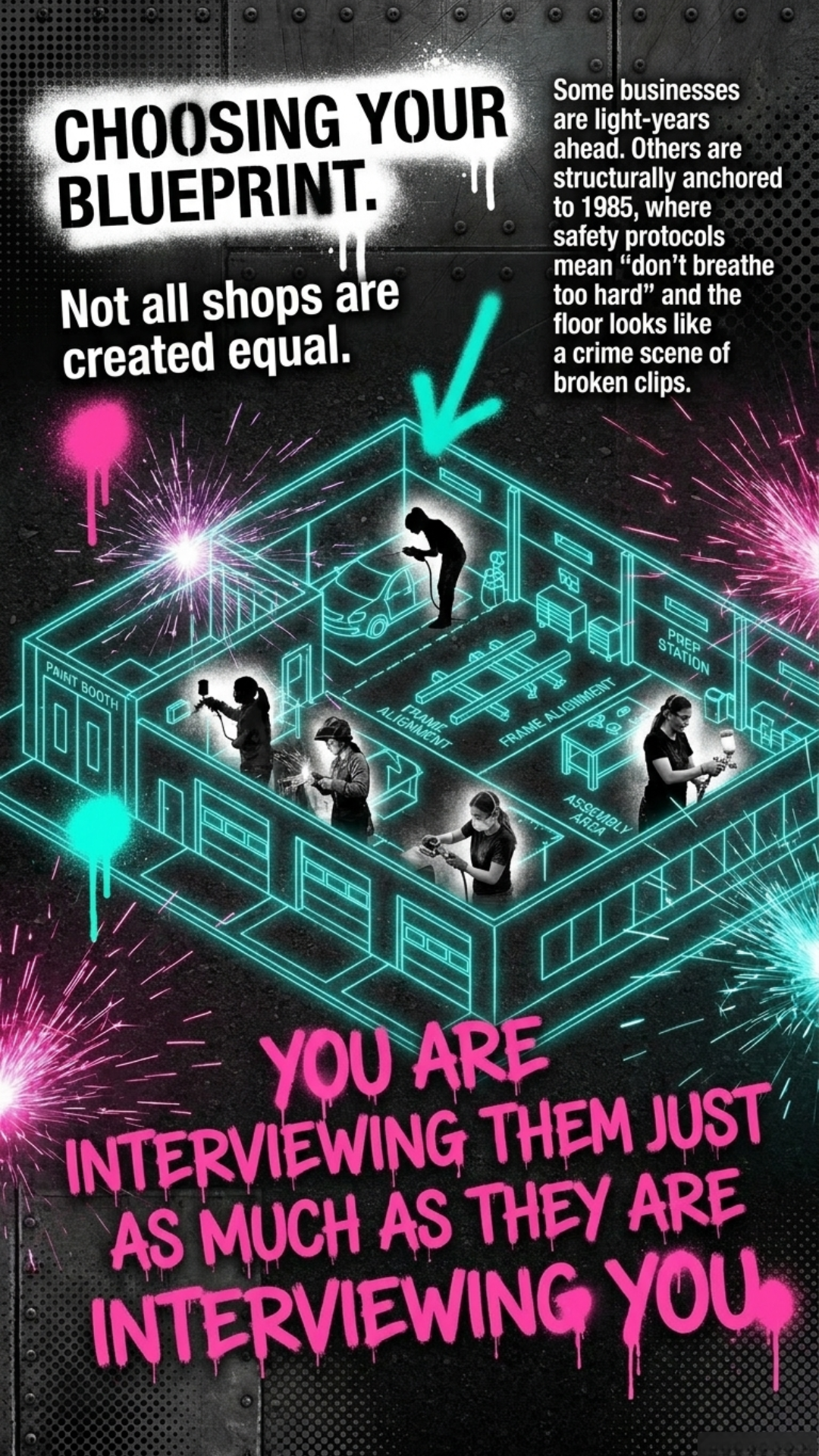
Choosing Your Career Path Blueprint
When you step past the threshold of an educational institution, the architecture of your career changes overnight – in a technical school lab, the goals are cleanly outlined on a syllabus, and your instructor is there to act as a safety net, but once you enter the real-world workforce, the metrics shift toward flat-rate hours, production speed, key performance indicators (KPIs) and cycle times. For a female technician entering this intense ecosystem, this transition requires an assertive, tactical approach. You cannot afford to passively wait for an opportunity to fall into your lap; you must actively construct your own path.
The baseline of this strategy begins with your first employment decision – finding the right workplace is just as critical as finding the right training program!
Not all shops are created equal. It is an unfortunate reality that structural and cultural quality varies wildly from shop to shop. Some businesses are light-years ahead, operating with clean, well-lit bays, advanced tooling and progressive leadership; others are still anchored to a bygone era, where safety protocols are ignored, and a female technician is viewed with an outdated sense of skepticism. They are still structurally anchored to 1985, where the safety protocols consist of “just don’t breathe too hard” and the shop floor looks like a crime scene littered with broken clips and ancient beef jerky wrappers.
This is why you must approach the job hunt with a selective mindset: you are interviewing them just as much as they are interviewing you.
When you tour a potential shop, apply a rigorous cultural and technical filter. Look past the polished front office where customers wait, drinking complimentary coffee that tastes remarkably like battery acid, and demand to see the back of the house. Step into the production bays and observe. How are the vehicles flowing through the stalls? Are the technicians working in a state of chaotic frustration, throwing wrenches at the drywall…or is there a rhythmic, collaborative flow? Are tools scattered haphazardly across body filler caked floors like an obstacle course…or does the shop implement an organized system that respects its assets?
The “Surface Tension” Facility Filter
- Operational Safety: Are local exhaust systems, eye-wash stations and structural safety gear fully operational and regularly checked, or are they holding up old calendars?
- Infrastructure Investment: Does the shop utilize modern measuring systems, clean downdraft spray booths and advanced spot welders?
- Team Communication: Do the estimators, parts managers and technicians speak to one another with professional clarity, or is it mostly grunting and pointing?
Crucially, evaluate their commitment to industry evolution. A shop that refuses to invest in modern frame machinery, aluminum repair spaces or advanced driver assistance systems (ADAS) calibration tooling is a shop that is slowly dying. If a facility is unwilling to invest in its own technical infrastructure, it certainly will not invest in your continuing education or career advancement.
Be direct with shop owners and production managers during your tours. Ask them how they handle the apprenticeship path: Do they have a clear, documented timeline for moving an apprentice from an initial teardown or prep role into a flat-rate stall, or do they simply use cheap entry-level labor to haul scrap and sweep floors indefinitely? Ask how they handle continuous training through organizations like I-CAR or specific vehicle OEM certifications.
Pay close attention to how they respond to your presence. If a shop owner seems overly fixated on your gender, drops condescending remarks under the guise of humor (like asking if you need a pink toolbox), or acts as if hiring you is a public-relations stunt rather than a strategic business decision based on your technical merit, walk away. While you’re walking the floor, do a thorough vibe check on the technicians currently in the stalls. There is a massive strategic advantage to doing this.
For starters, miserable techs are like a glowing check engine light—if they hate the shop, they will practically trip over themselves to dump their diagnostic codes on you. Your job is to filter the raw data: are they exposing legitimate operational bottlenecks (like broken equipment and parts delays), or are they just chronic grumblers who hate their lives and the flat-rate system in general?
Secondly, this interaction gives you an immediate preview of how they’ll treat you on a random Tuesday. If a tech decides to fly his caveman flag right in front of you during a tour, consider it a gift. It’s a live-action demo of how management operates under pressure. Does the boss shut that behavior down immediately, or do they give you the classic, spineless shrug: “Oh, that’s just Old-School Bob, he doesn’t mean anything by it”?
If the manager plays zookeeper instead of a leader, you have all the data you need. Decide right then and there whether a facility is worth your time, or if you should take your talents to a shop that actually operates in the current century.
Your skills are an economic asset! Never give your time, talent, physical labor, or sanity to a business that treats your presence as an anomaly rather than an upgrade to their production line. Ladies, let’s be entirely honest here: I’ve already warned you that this industry is hard work. Because of that, you need to look at your first industry job the exact same way you look at a first husband. Specifically, let’s try really hard not to let our first shop choice become our bitter ex-husband.

You know the type—the one that absolutely stole your youth. Think back to when we still possessed pristine lower backs, fully functioning knee cartilage, and the physiological ability to drop it like it’s hot out on the dance floor, only to effortlessly roll into work the next morning like we hadn’t been dancing all night long. Yeah, if you let it, a bad shop will drain you of that exact same vitality, leave you with nothing but a toolbox full of regret, and expect a thank-you note. Your time is money! Every second of every day represents your personal economic value, and you have way too much intelligence to waste it in a workspace that doesn’t appreciate you.
The Interview: Shattering the Desk-Job Bias
While the trade is definitely modernizing, let’s be real: there are still plenty of knuckle-dragging neanderthals roaming the shop floors who completely missed the memo on human evolution. You are inevitably going to run into a few fossils whose technical certifications are up-to-date, but whose internal social diagnostics are pulling nothing but error codes. When a young woman walks into a body shop with an application, many traditional managers will instinctively assume she is applying for a customer service role, a front-desk position or an entry-level estimating job. They might look at you and see someone who should be answering phones and coddling DRP reps rather than sectioning frame rails. There is absolutely nothing wrong with those vital career paths, but if your goal is to spend your days in a paint booth or welding a quarter panel, you must shatter that front-office expectation before a single question is asked.
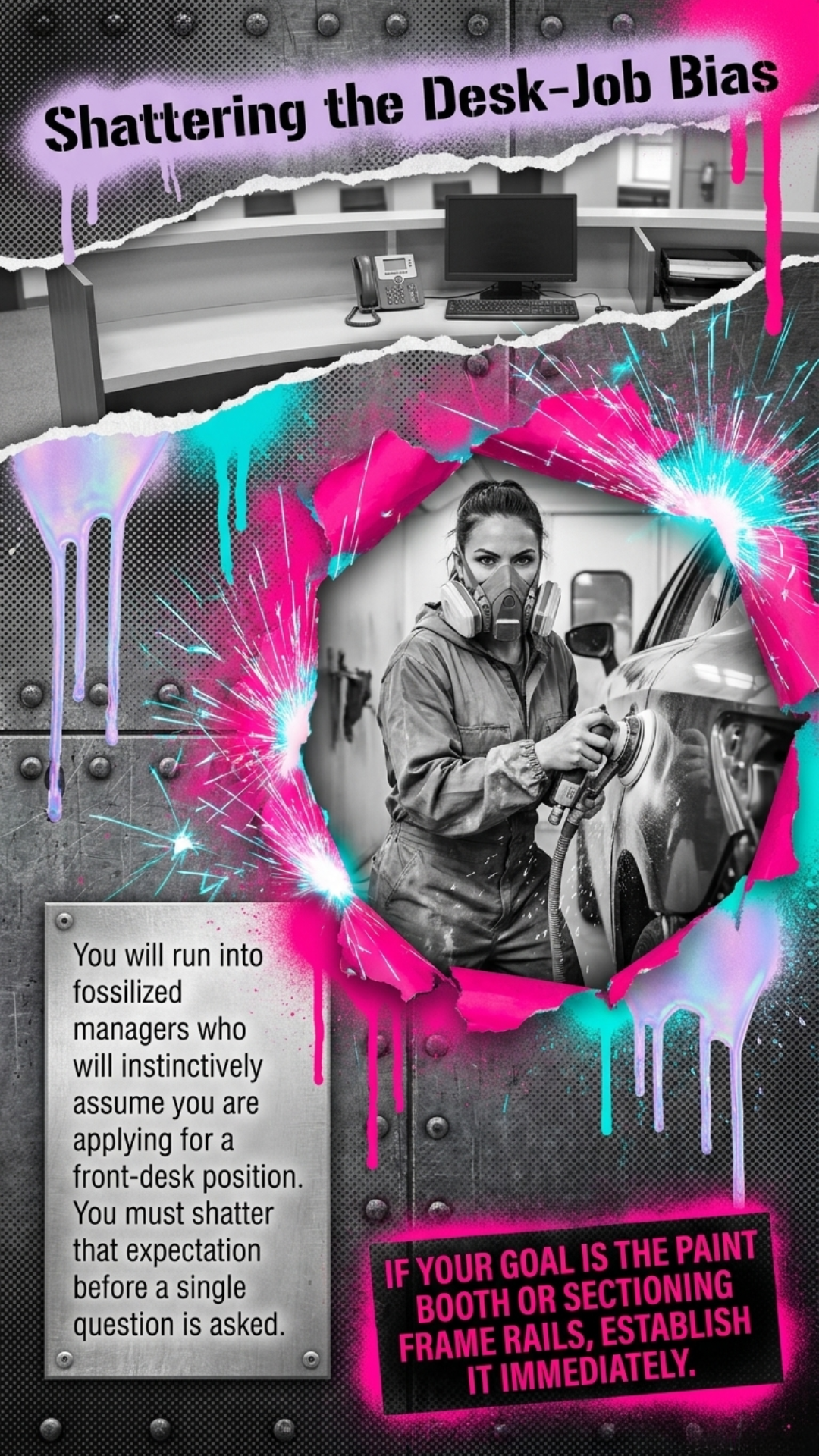
Your interview strategy should be a masterclass in professional execution and immediate readiness. You want to arrive looking sharp and put-together, signaling that you treat the business opportunity with complete seriousness; however, your appearance must also be backed by functionality. Do not show up in delicate office attire or high heels that make walking across a live production floor look like a high-wire balancing act. Instead, wear durable, clean work trousers and a professional polo or branded collared shirt.
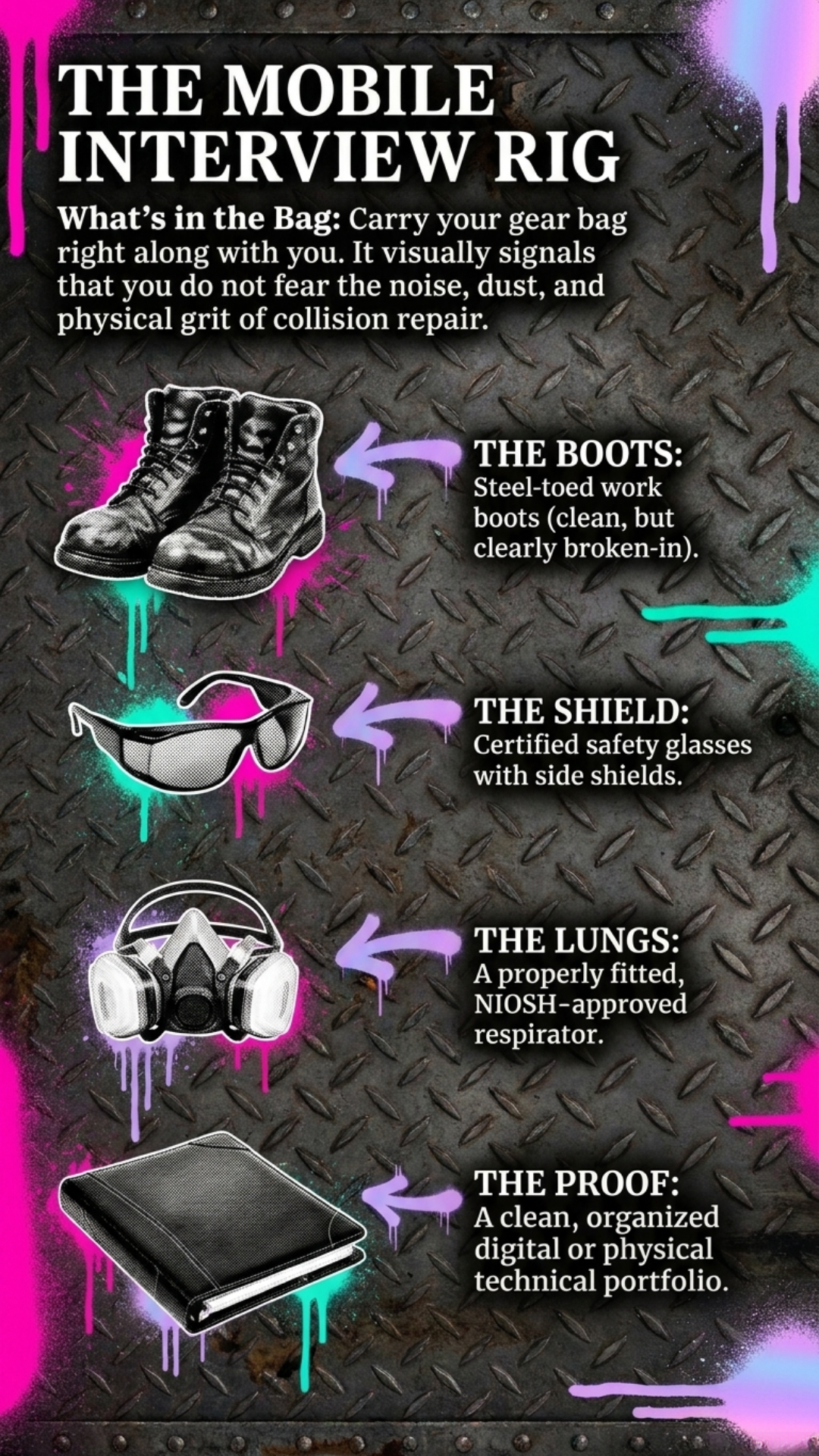
Most importantly, carry your tool or gear bag right along with you. Inside that bag should be your broken-in steel-toed work boots, your safety glasses and your respirator. This simple visual cue completely alters the dynamic of the meeting. It lets the hiring manager know immediately that you do not fear the grit of collision repair – the noise, the dust and the physical demands of the shop floor.
When the conversation shifts to your technical abilities, don’t rely solely on verbal descriptions of your school lab projects… Bring the evidence. Hand them an organized portfolio containing photographs of your work. One recommendation that I always made to my students was to somehow organize photos in a drive or a file that could be shared or emailed to the manager. Show them clean, sectioning weld tests that you have passed. Show them high-resolution images of complex plastic tab repairs you have executed, or panels you prepped, blocked and sprayed. If you have kept track of your diagnostic scanner work or structural measurement printouts from your school lab, present them.
Your Mobile Interview Rig:
- A clean, organized digital or physical technical portfolio
- Certified safety glasses with side shields
- Steel-toed work boots (clean, but clearly broken-in)
- A properly fitted NIOSH-approved respirator
If you sense any underlying skepticism from the interviewer regarding your repair competence or your willingness to jump into the fray, call their bluff with calm confidence.
Look the manager in the eye and say: “I have my boots and safety gear in my bag. If you have an open stall or a senior technician available right now, I am completely ready to go out to the floor and execute a live weld test or perform a tear-down objective, so you can see my efficiency first-hand.”
This level of professional assertiveness changes the entire power dynamic. It transforms you from a passive applicant hoping for a chance into a confident professional offering to prove your economic production capability on the spot. Even if they decline the live test, the message is received loud and clear: you are a technician, you are here to build, and you know exactly how to handle the tools of the trade.
The Finish Line is Just the Starting Block
Class of 2026, the transition from the classroom to the shop floor is the ultimate glow-up. By vetting your future shop with a critical eye and walking into interviews with your gear bag in hand, you aren’t just looking for a job – you’re staging a takeover. You’ve proven you’re “too Glossed to care” about the outdated stereotypes and “too Gritty to quit” when the work gets tough. These are your first high-velocity steps toward a legendary career!
But don’t shift into park just yet. This is only the beginning of my “New Grad” series. I’m dedicating the next few installments of this column to helping you navigate the “real world” hurdles that a syllabus can’t prepare you for:
- June e-News: Tune in for tactical tips on negotiating a tool allowance (don’t leave money on the table!) and survival strategies for navigating your first year on the shop floor.
- Issue 2, coming in June: Make sure to subscribe for this deep dive. I’ll be talking about taking command of your career path options and the essential skills for confronting bias in the workplace without losing your cool or your momentum.
Remember, Collision DisruptHERs: The industry is waiting for your impact. Let’s get to work!
The Pipeline Just Got Stronger:
Collision Engineering Earns National Recognition
The future of collision repair just got a major co-sign from the federal government – and honestly, it’s well deserved.
The Collision Engineering Career Alliance (CECA) was recently awarded National Guidelines for Apprenticeship Standards (NGS) recognition by the U.S. Department of Labor, officially validating its apprenticeship model as a national framework for training and certifying collision engineering technicians.
Translation? The industry’s ongoing workforce conversation is finally turning into real, scalable action!
For years, collision repair leaders have sounded the alarm about technician shortages, evolving vehicle technology and the urgent need for stronger talent pipelines. Collision Engineering didn’t just acknowledge the problem – it built an entirely different roadmap.
The program combines classroom education with paid, real-world apprenticeships, allowing students to rotate every eight weeks between college instruction and hands-on shop experience. Graduates leave with a two-year associate degree, industry experience and employer connections… and now, it’s all tied to a nationally-recognized credential from the Department of Labor.
That matters – not just because it elevates the credibility of collision repair education, but also because it helps reshape how young people (and their parents, counselors and communities) view careers in this industry. Collision repair is no longer being positioned as a backup plan; it’s being recognized as a highly technical, high-skill career path deserving of structured workforce investment.
And that shift? That’s a Collision DisruptHER-level move!
“The Department of Labor’s approval of our National Guidelines for Apprenticeship Standards is a defining moment for Collision Engineering,” said John Helterbrand, national program director. “It validates the work we have done to align education and industry, and it ensures students and employers alike can access a pathway that is nationally recognized and sustainable for the future.”
At Glossed & Gritty, we talk often about the importance of building the future of collision repair intentionally – not reactively. Programs like Collision Engineering are doing exactly that by connecting schools, shops and industry leaders in ways that create long-term sustainability instead of short-term staffing fixes.
Collision Engineering President Mary Mahoney emphasized that the program’s success is rooted in collaboration across the industry, with partner schools and repair facilities working together to create stronger opportunities for students entering the trade.
And perhaps one of the most important pieces of this entire initiative is accessibility. Students aren’t expected to choose between education and earning a paycheck. They’re able to learn while actively working in the industry, reducing barriers that often prevent talented young people from pursuing technical careers in the first place.
That’s not just workforce development – that’s workforce evolution.
Collision Engineering currently partners with schools across the country, including College of Lake County, Contra Costa College, Parkland College, Metropolitan Community College, Sandhills Community College, North Dakota State College of Science and El Camino College – creating a growing national network focused on producing career-ready technicians equipped for modern collision repair.
As vehicles continue advancing, the industry needs technicians trained not only to repair cars, but to understand the increasingly complex engineering behind them. Collision Engineering is proving that future-ready training isn’t optional anymore; it’s essential.
And now, it’s federally recognized.
From Classroom to Collision Career: WIN Supports 39 Rising DisruptHERs
More than 39 future Collision DisruptHERS are stepping into the industry with a little extra support behind them.
The Women’s Industry Network (WIN) recently awarded more than $50,000 in scholarships, mentorship opportunities and professional shop tool sets to collision repair students across North America through its 2026 WIN Student Scholarship Program.
Selected from more than 100 applicants, this year’s recipients represent the next generation of technicians, painters, leaders and changemakers helping reshape the future of collision repair.
Through its Champions, Trailblazers and Legends levels – as well as its new Northern Star scholarships for Canadian students – WIN continues investing directly into the industry’s talent pipeline, proving that supporting women in collision repair isn’t just a conversation; it’s actionable. Beyond financial support, recipients also gain access to mentorship, networking opportunities, student engagement calls and industry connections designed to help create long-term career growth and retention within collision repair.
In other words: these students aren’t just receiving scholarships – they’re gaining a community.
“WIN’s commitment to driving the future of the industry is anchored by our investment in women aspiring to work in collision repair,” said Tracy Bracht, 2026 Chair of the WIN Student Relations Committee. “Student membership provides access to valuable resources and opportunities that support them throughout their journey. There is no cost for student memberships, thanks to the generous support of our generous sponsors and members!”
The Collision Repair Education Foundation (CREF) again partnered with WIN this year to help expand the program’s reach and connect more students with opportunities to launch successful careers in the industry.
From toolboxes to tuition assistance, the program helps remove barriers many students face while entering the trade – especially aspiring technicians balancing education costs alongside the expense of building professional-grade tool collections.
The 10 young women who were named 2026 Champions received a $2,500 scholarship, mentorship, shop tools, WIN merchandise and a WIN Conference virtual pass. Congratulations to:
- Angelica Briones – Tennessee College of Applied Technology (Chattanooga, TN)
- Leah Clarke – Wilkes Community College (Wilkesboro, NC)
- Alice Cook – Collin College (Lewisville, TX)
- Jennifer Cruz – El Camino College (Hawthorne, CA)
- Courteney Lafrenz – Southeast Technical College (Larchwood, IA)
- Izzy Malloy – Pennsylvania College of Technology (Carlisle, PA)
- Emerald Manuel – Northeast Community College (Norfolk, NE)
- Jacqueline Nguyen – Portland Community College (Hillsboro, OR)
- Rachel Santafemia – North Georgia Technical College (Gainesville, GA)
- Addison Zick – Pennsylvania College of Technology (Norristown, PA)
Nine Trailblazers were awarded a $500 scholarship, entrance into WIN’s mentorship program and a WIN Conference virtual pass.
- Josephine Barbour – Wake Tech Community College (Creedmoor, NC)
- Elizabeth Caspers – Rock Valley College (Belvidere, IL)
- Tausha French – American River College (Sacramento, CA)
- Katelyn Jenkins – Palomar College (Temecula, CA)
- Electra Lucero – Madison Area Technical College (Madison, WI)
- Kennedy McDaniel – Des Moines Area Community College (Des Moines, IA)
- Alyssa Meadows – St. Cloud Technical & Community College (East Bethel, MN)
- Lisa Sanchez – Bellingham Technical (Ferndale, VT)
- Madison Warren – Unaka High School (Elizabethton, TN)
This year’s Legends received shop tools, WIN merchandise, mentorship opportunities and a WIN Conference virtual pass.
- Alexis Arjon – South Plains College (Levelland, TX)
- Autumn Burrows – Puget Sound Skills Center (Kent, WA)
- Emily Carroll, Hennepin Technical College (Roseville, MN)
- Gabriella De Leon Humes – Lincoln College of Technology (Fort Thomas, KY)
- Olivia Dellinger – Wilkes Community College (Hays, NC)
- Jolie Keigley – Des Moines Area Community College (Ames, IA)
- Tory Matthews – Metropolitan Community College (Omaha, NE)
- Jocelyn Pandolfo – Pennsylvania College of Technology (Clark, NJ)
- Tia Wolffe – Kennedy King College (Homewood, IL)
- Taralynn Wright – Tulsa Tech (Broken Arrow, OK)
New in 2026, WIN awarded Northern Star scholarships to Canadian students in two levels. Recipients of $1,000 scholarships included:
- Sophia Branco-Silva – Centennial College (Whitby, Ontario)
- Amelia Desbiens – Central Memorial High School (Calgary, Alberta)
- Kianna Edison – St. Thomas Aquinas High School (Kenora, Ontario)
- Aleisha Smith – Okanagan College (Kelowna, British Columbia)
- Teila Wandowich – Red River Polytech (Winnipeg, Manitoba)
The following students were awarded $500 scholarships:
- Torrie Crowe – Southern Alberta, Institute of Technology (Calgary, Alberta)
- Shanika Dick – Centennial College (Toronto, Ontario)
- Cassandra Foy – Red River Polytech (St. Andrews, Manitoba)
- Jordan Pomanski – Red River Polytech (Winnipeg, Manitoba)
- Evelyn Torres – Centennial College (Toronto, Ontario)
Learn more about WIN’s Scholarship Program.


(Winners pictured above from left to right: Olivia Dellinger, Leah Clark, Jolie Keigley, & Jacqueline Nguyen)
These Girls Got Skills – and the Medals to Prove It!
Every year, the best of the best trade students battle it out at the SkillsUSA State Leadership and Skills Conferences for a shot at the national spotlight – but in 2026, the girls didn’t just show up; they dominated!
Throughout the nation, female competitors racked up medals for Automotive Refinishing Technology, Collision Repair Technology and Collision Damage Appraisal in a way that turned heads, shattered expectations and proved the next generation of skilled tradeswomen isn’t coming in quietly… They’re in it to win it!
“SkillsUSA is a national nonprofit organization that partners students, instructors, and industry to ensure America has a skilled workforce,” explains Sarah Stillahn, Vice Chair of the Nebraska Auto Body Association (NABA), who helped organize the Nebraska State Collision Competition. “Through hands-on competitions like this, students are evaluated on real-world industry standards, helping bridge the gap between the classroom and the shop.”
While the student competitors are the stars of the show, Sarah points out, “The success of this event depends heavily on the involvement of industry professionals, local shops and vendor partners. From donating time and equipment to judging, mentoring and sponsoring, their support ensures students are evaluated to current industry standards while also building meaningful connections within the trade. These partnerships are critical to developing the next generation of collision repair professionals.”
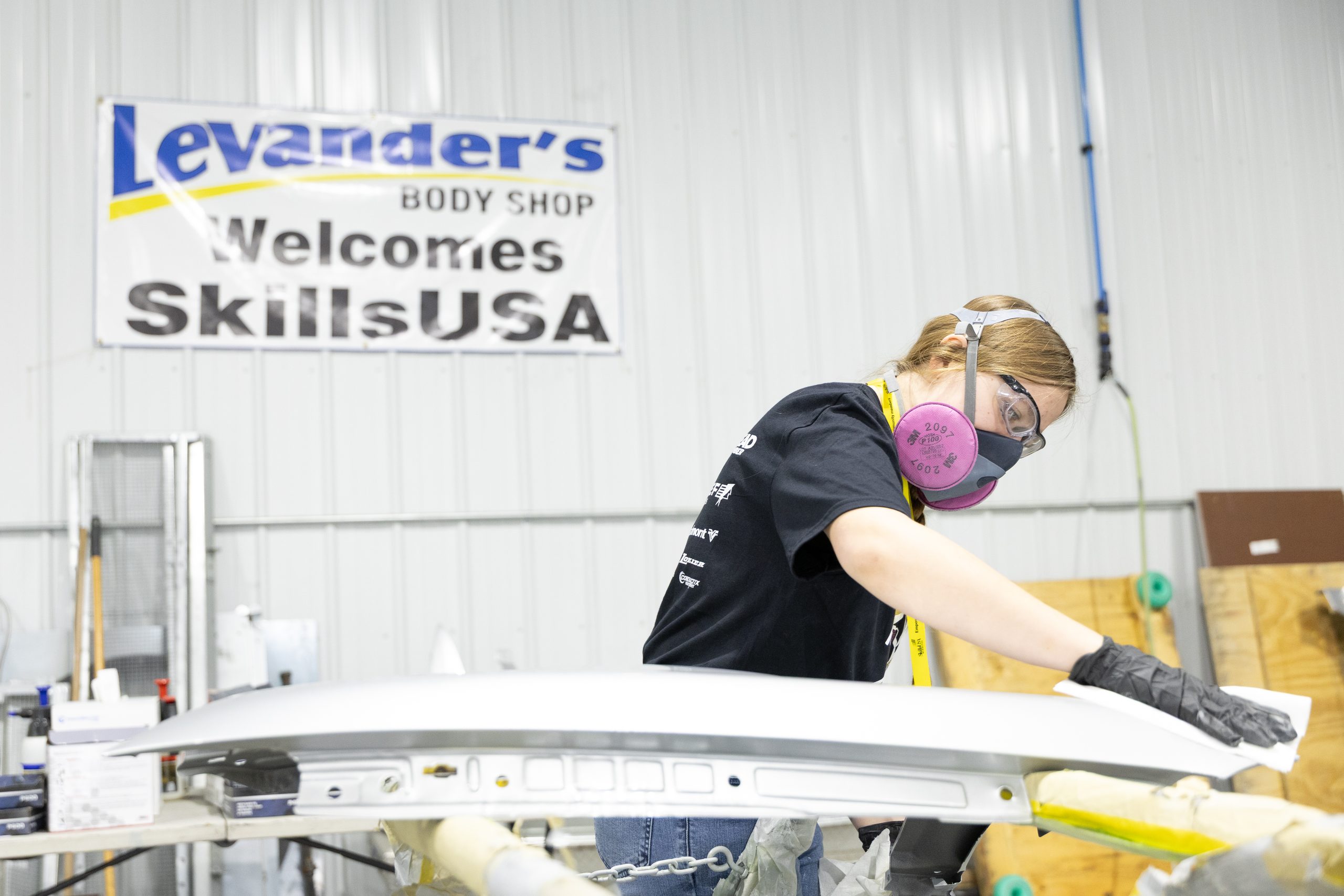
She applauds the local organizations and individuals who stepped up: “Levanders in Grand Island generously provided the facility – including a paint booth – for the Collision Repair and Refinishing competitions. Volunteers supplemented the space by bringing in additional equipment, creating a true real-world shop environment and delivering a meaningful, hands-on experience for students. In past years, volunteers faced challenges creating this type of environment due to limited facilities, so Levanders’ willingness to step in and open their doors has been a significant and appreciated addition to the program!”
Overall participation was fairly strong with 46 competitors representing five high schools and three colleges; however, Sarah would have liked to see more participation in the Collision Damage Appraisal Competition. “Increasing awareness and involvement in this category is important, as it plays a critical role in the repair process and offers strong career opportunities within the industry. We encourage instructors and students to explore this path and get involved in future competitions.”
In fact, she would love to see more involvement in every collision competition. Sarah observes that only three colleges participated in the Nebraska State Competition and expresses concern that “one of those programs is scheduled to close after the next school year – highlighting the ongoing need to support and grow collision repair education in Nebraska.” She urges industry professionals to get involved with their local programs to ensure they remain viable.
NABA also encourages schools and students to reach out to the association “if travel or resources are a barrier to participation. Our goal is to support student involvement however we can and help ensure that those who want to compete have the opportunity to do so!
“SkillsUSA provides an important platform for young professionals to demonstrate their skills, build confidence and experience a sense of accomplishment,” Sarah adds. “Many students enter the competition already having secured positions or sponsorships with industry companies, while others often leave with job offers, especially at the national level, thanks to the exposure and connections these events provide.”
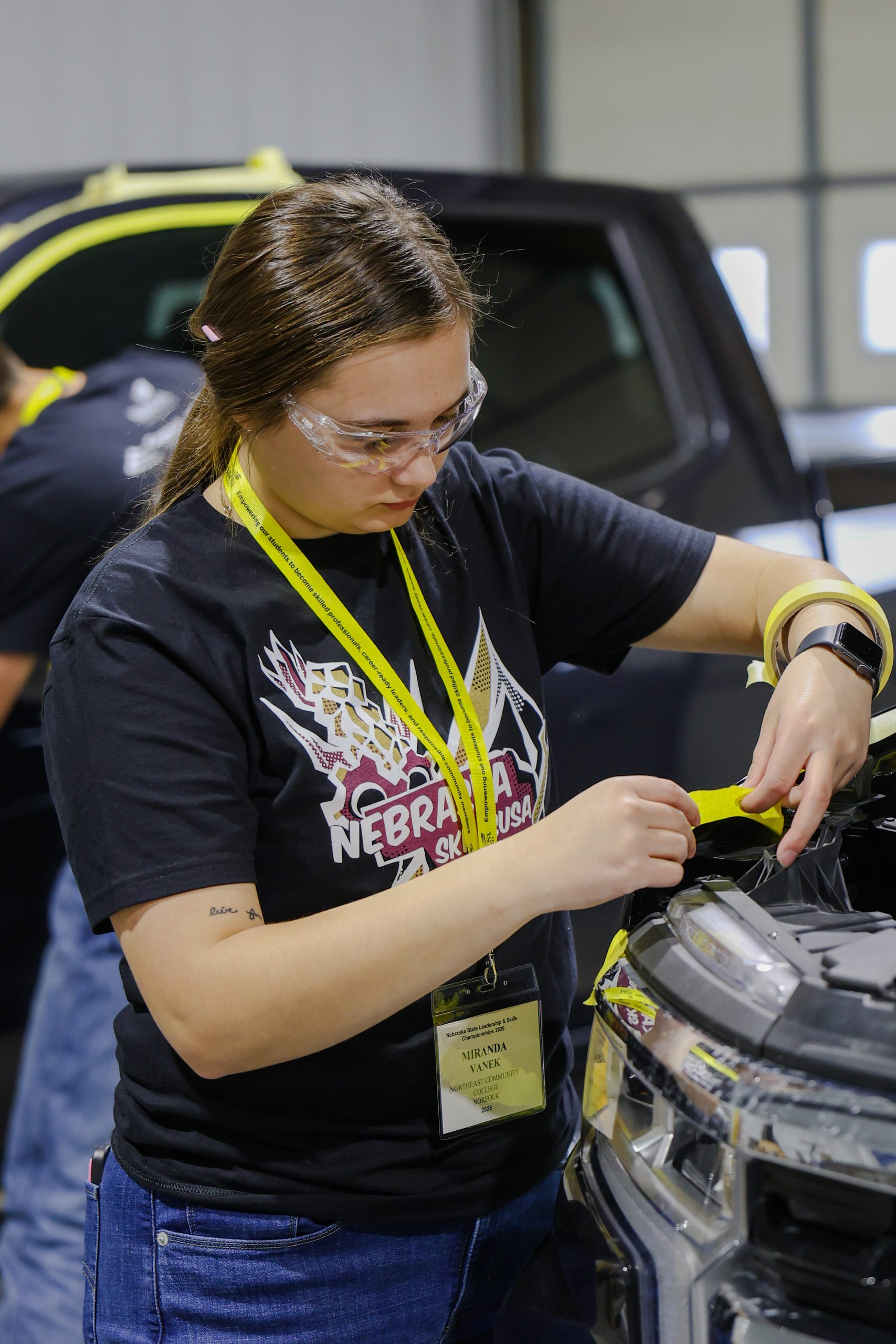
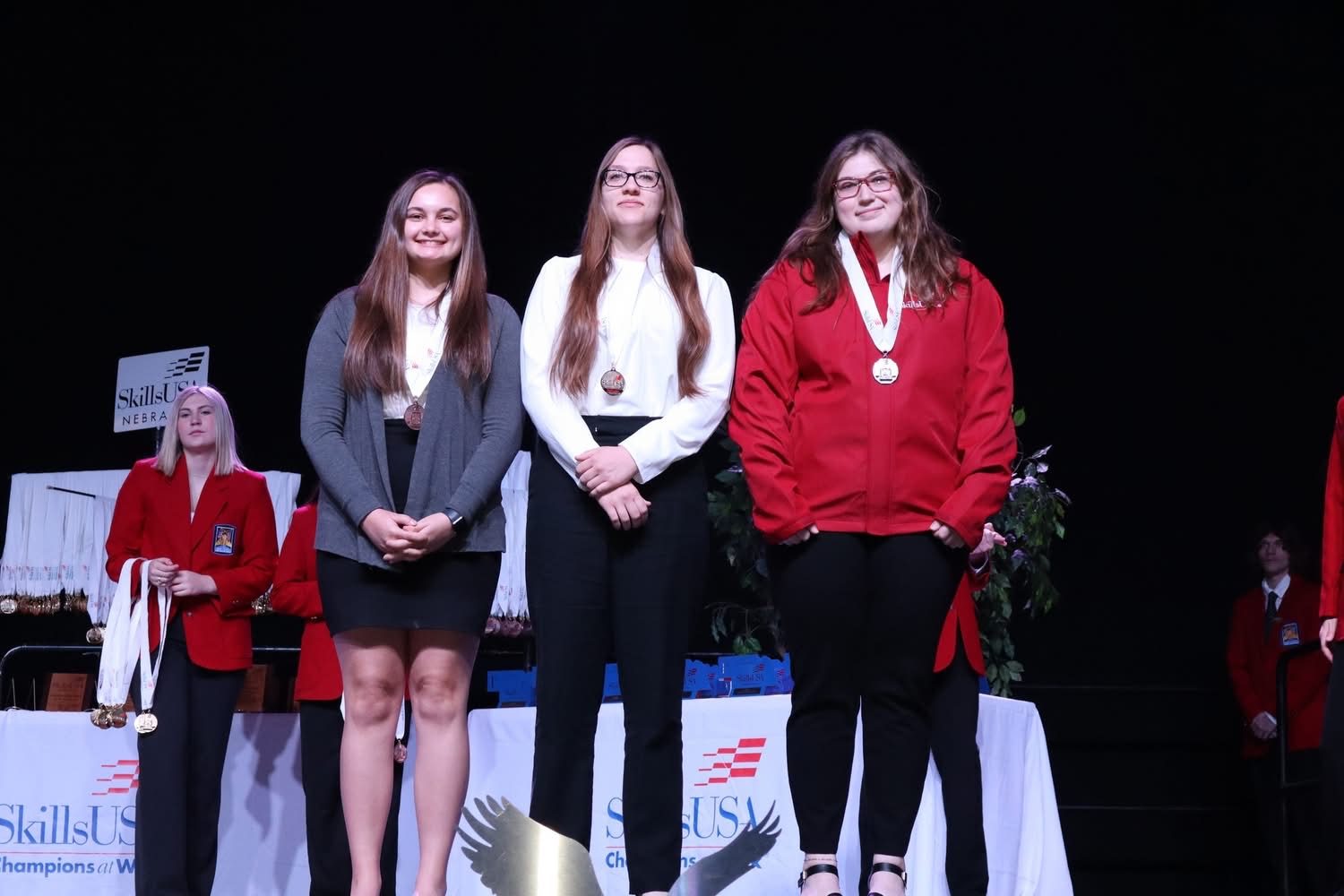
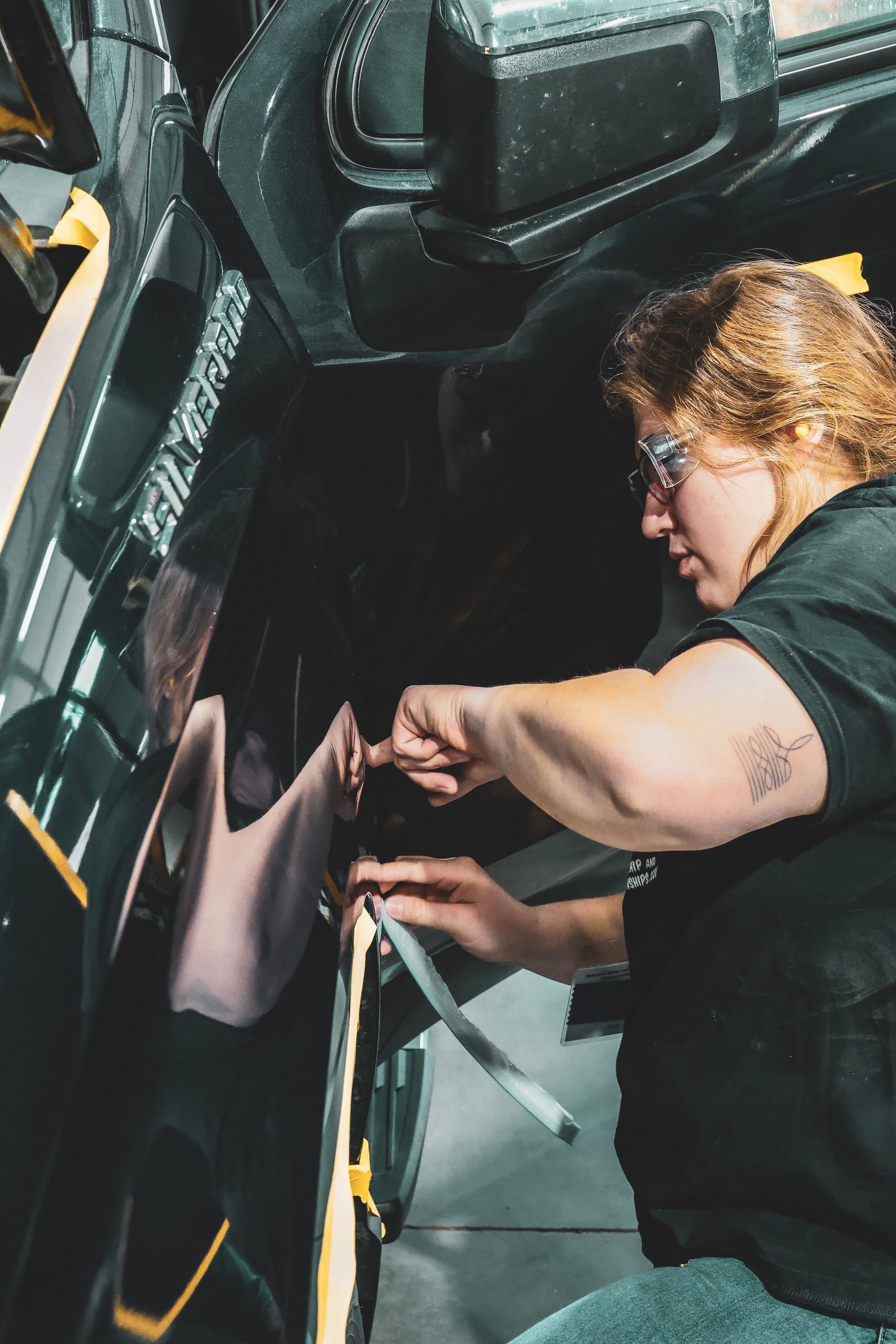
While female competitors brought serious talent to every corner of the SkillsUSA Nebraska State Collision Competition, the real takeover happened in college-level Automotive Refinishing, where the women swept the podium and claimed all three medals. The booth was packed with tenacity, precision and unapologetic DisruptHER energy – proving the future of refinishing is looking a whole lot more female.
Congratulations to Gold medalist Emma Uhler (Southeast Community College – Milford; Milford, NE), Silver medal winner Callie Nickerson (Metropolitan Community College; Omaha, NE) and Bronze winner Miranda Vanek (Northeast Community College; Norfolk, NE)!
Nebraska wasn’t the only state where young women took over the Automotive Refinishing Technology scene. Across the country, female competitors proved their eye for color, detail and precision is next-level – turning heads, stacking medals and bringing the “Gloss” to SkillsUSA at the state level! The “Grit” was definitely part of the equation too, with plenty of women earning medals in Collision Damage Appraisal and Collision Repair Technology.
Glossed & Gritty proudly celebrates every student competitor – women and men alike – but our mission is spotlighting the women kicking ass, breaking barriers and making waves in the skilled trades, so we’re highlighting the ladies* who brought home medals in states across the country…over six dozen medals!
(*Editors’ note: We did our best to identify female competitors based on the names provided in the results lists and subsequent research. If anyone was unintentionally missed or incorrectly identified, we sincerely apologize; the goal is to celebrate and recognize the incredible talent and accomplishments of the young women making their mark in collision repair.)
Automotive Refinishing Technology
Gold:
- Allonna Vidrine (Terrebonne Career and Technical High School; Houma, LA) – High School
- Bridget Dunfee (WyoTech; Laramie, WY) – College
- Brookelyn Meents (Lake Career and Technical Center; Camdenton, MO) – High School
- Chesey Johnson (Madison County Career Technology Center; Huntsville, AL) – High School
- Ella Parsons (Northeast State Community College; Blountville, TN) – College
- Elizabeth Rolen (Washington County Career & Tech Ed Center; Abingdon, VA) – High School
- Isabella Roll (North Dakota State College of Science; Wahpeton, ND) – College
- Jasmine Hansen (Southwestern Community College; Creston, IA) – College
- Kaelyn Brilliant (Capital Area Technical Center; Augusta, ME) – High School
- Katie Dobrinski (Morgan Community College; Fort Morgan, CO) – High School
- Megan Pierret (Aims Community College – Windsor; Greeley, CO) – College
- Olivia Dillinger (Wilkes Community College; Wilkesboro, NC) – High School
Silver:
- Brenna Leuty (Washburn Tech; Topeka, KS) – High School
- Dana Chick (Cape Fear Community College; Wilmington, NC) – College
- Evangeline Utley (Bingham H/S; South Jordan, UT) – High School
- Isabelle Mayberry (Orange Technical College – South Campus; Orlando, FL) – College
- Makayla Ball (Autry Technology Center; Enid, OK) – College
- Mariana Millan (Hutchinson Career & Technical Academy; Hutchinson, KS) – College
- Nicole Fejfar (West-MEC NE Campus; Phoenix, AZ) – High School
- Olivia Rhodes (Maxwell High School of Technology; Lawrenceville, GA) – High School
- Sydney Stiarwalt (Lewis and Clark Career Center; Saint Charles, MO) – High School
Bronze:
- Allison Dyke (Bismarck State College; Bismarck, ND) – College
- Annabelle Weaver (Northern Neck Technical Center; Warsaw, VA) – High School
- Aiyana Herrera (Pickens Technical College; Aurora, CO) – College
- Dalia Alcala (Yakima Valley Skill Center; Yakima, WA) – High School
- Daylan Dooley (Athens Technical College; Athens, GA) – College
- Emily DeBeaubien (Iredell-Statesville Career Academy & Tech School; Troutman, NC) – High School
- Kierra Hamilton (Tennessee College of Applied Tech-Knoxville; Knoxville, TN) College
- Leah Clarke (Wilkes Community College; Wilkesboro, NC) – College
- Joselyn Marquez (Granger H/S; West Valley City, UT) – High School
- Savannah Pepcorn-Maybon (MSU Billings-COT; Billings, MT) – College
- Savannah Martin (Paul M. Hodgson Vo-Tech; Newark, DE) – High School
- Sindel Mendez De La Cruz (Salt Lake Community College; Salt Lake City, UT) – College
Collision Damage Appraisal
Gold:
- Ashley Salas (Dr. Kirk Lewis Career and Technology High School; Houston, TX) – High School
- Cloud Kline (Aims Community College – Windsor; Greeley, CO) – College
- Deanna Lewis (Lanier Technical College; Gainesville, GA) College
- Elsie O’Neill (Center of Applied Tech North; Severn, MD) – High School
- Emmalee Johnson (Northeast State Community College; Blountville, TN) – College
- Guadalupe Ayala-Segura (Delcastle Technical High School; Wilmington, DE) – High School
- Isabell Schmidt (South Central College; MN) – College
- Madison Warren (Unaka High School; Elizabethton, TN) – High School
- Paige Reynolds (Francis Tuttle Technology Center; Oklahoma City, OK) – College
- Samantha Rhea (Russell County Career & Tech Center; Lebanon, VA) – High School
- Tania Lugo (Manatee Tech College; Bradenton, FL) – College
Silver:
- Abbigail C. Hypes (Academy of Careers & Technology; Beckley, WV) – High School
- Angelica Vargas (Granger High School; West Valley City, UT) – High School
- Autumn Loper (Paul M. Hodgson Vo-Tech; Newark, DE) – High School
- Diana Perry (Aims Community College – Windsor; Greeley, CO) – College
- Hali Ramos (Gordon Cooper Technology Center; Shawnee, OK) – College
- Kallie O’Neill (Washington County Career & Tech Ed Center; Abingdon, VA) – High School
- Rachel Becker (Southwestern Community College; Creston, IA) – College
Bronze:
- Bronwyn Aloi (Delcastle Technical High School; Wilmington, DE) – High School
- Gabriella Cioffi (Canadian Valley Tech Center; El Reno, OK) – High School
- Kytalynn Huber (Moore Norman Technology Center; Norman, OK) – College
- Merianne Yakaitis (Franklin Technology Center; Joplin, MO) – High School
Collision Repair Technology
Gold:
- Alexis Skowronski (Manatee Tech College; Bradenton, FL) – College
- Ariel Owens (Polytech High School; Woodside, DE) – High School
- Avery Mitchell (East Valley Institute of TEchnology; Mesa, AZ) – College
- Kaelan Merlowe (Lanier Technical College; Gainesville, GA) – College
- Evelin Spiece (Oakland Schools Technical Campus NW; Clarkston, MI) – High School
- Layla Wilson (Washington County Career & Tech Ed Center; Abingdon, VA) – High School
- Tolulope Adegoke (Thomas Edison High School of Technology; Silver Spring, MD) – High School
Silver:
- Miranda Eckhardt (Aims Community College – Windsor; Greeley, CO) – High School
Bronze:
- Ellie Ream (Eden Area ROP; Hayward, CA) – High School
- Emma Fitzgerald (Technology, Exploration & Career Center West; Lewisville, TX) – High School
- Jacqueline Alvarez Rios (Delcastle Technical High School; Wilmington, DE) – High School
- Kasadee Burden (Warrensburg Area Career Center; Warrensburg, MO) – High School
- Keisha Caynor (Randolph Technical Center; Elkins, WV) – High School
- Kimberly Alcala (Yakima Valley Skill Center; Yakima, WA) – High School
- Madison LaTour (Center for Instruction, Technology & Innovation; Mexico, NY) – High School
- Nina Poplawski (HH Ellis Technical High School; Danielson, CT) – High School
- Olivia Chivers (Aims Community College – Windsor; Greeley, CO) – College
Gold medalists now have the opportunity to advance to the National SkillsUSA Leadership & Skills Conference and Championships in Atlanta this June, where they’ll compete against the best student talent in the country. Glossed & Gritty is cheering on every one of these Primed DisruptHERs as they take their skills to the national stage and continue reshaping the future of collision repair.
ATTN: State winners – All 2026 state medal winners are invited to receive a complimentary three-month membership upgrade to Surface Tension. Simply sign up for a free membership first, then email Jannifer@glossedandgritty.com to request your upgrade.
We’d also love to highlight the ladies who will be competing at Nationals, and we invite you to share any updates by tagging @GlossedandGritty on your favorite social media platform so we can broadcast your accomplishments!
Nebraska SkillsUSA Competition


FRAMECHANGER
From Earning a Gown to Engineering Careers:
Laura Lozano’s Mission to Support Future Technicians

We call female collision repair instructors “Frame Changers” because they’re helping reshape the industry at its foundation. By educating, mentoring and empowering the next generation of technicians and leaders, they’re changing perceptions, opening doors and influencing the future of collision repair long before students ever step into a professional shop. Their impact doesn’t stop with the students they teach – it carries into the culture, workforce and future direction of the industry itself.
Collision repair wasn’t a path Laura Lozano deliberately mapped out from the beginning – it was something she grew into through family influence, hands-on experience and a series of pivotal moments that gradually made the industry feel like home.
Her father has been a technician her entire life and remains active in the industry today. Growing up, she knew he worked on cars, but she didn’t fully understand collision repair or the scope of the industry behind it. It was simply “Dad’s work” – familiar but not truly defined.
That changed her senior year when Laura asked her dad for money for a prom dress. Instead of simply giving her the money, he offered a different path: come work with him for a week and earn it. At the time, he was working in a BMW-certified collision repair shop. It was a facility that immediately stood out – clean, highly organized and operating with a level of precision that made everything feel intentional.
That first day, Laura wasn’t focused on the technical work; she was observing. But something shifted when she began paying attention to what was actually happening around her – the process, the flow, the problem-solving and the craftsmanship involved in returning vehicles to pre-loss condition was fascinating. By the end of that week, Laura had earned her prom dress… and she had also gained a new perspective. She wanted to come back.
Like many students approaching the end of high school, Laura had started thinking about what came next, and now she had a pretty clear idea of what she wanted to do. As she spent the summer after graduation working in the shop, she quickly realized she couldn’t get enough – that she had discovered her path.
Around that time, she began learning about different educational pathways in collision repair. Her family didn’t have the resources to support a traditional four-year college experience, so when she learned about Contra Costa College, a local community college with a collision repair program just 30 minutes from her home, she knew she’d found the solution; it was affordable, practical and accessible.
Laura earned her associate degree while continuing to work part-time and during summers as her father’s apprentice. That combination of classroom learning and real-world application became the foundation of her development in the industry.
After graduation, she transitioned into full-time work at the shop. Working under her father created a unique learning environment built on trust and familiarity. Mistakes weren’t punished – they were worked through. If something broke, they fixed it together. That dynamic allowed her to grow quickly and confidently, developing skills without the fear of being pushed out for learning.
As time went on, she and her father became co-owners of their own collision repair shop and operated it together for seven years. That period became a formative chapter in her career. She gained exposure to every aspect of the business: refinishing, estimating, insurance relations, parts coordination, administrative operations and customer communication. More than anything, she developed a deep understanding of how all the moving pieces of a collision repair facility connect.
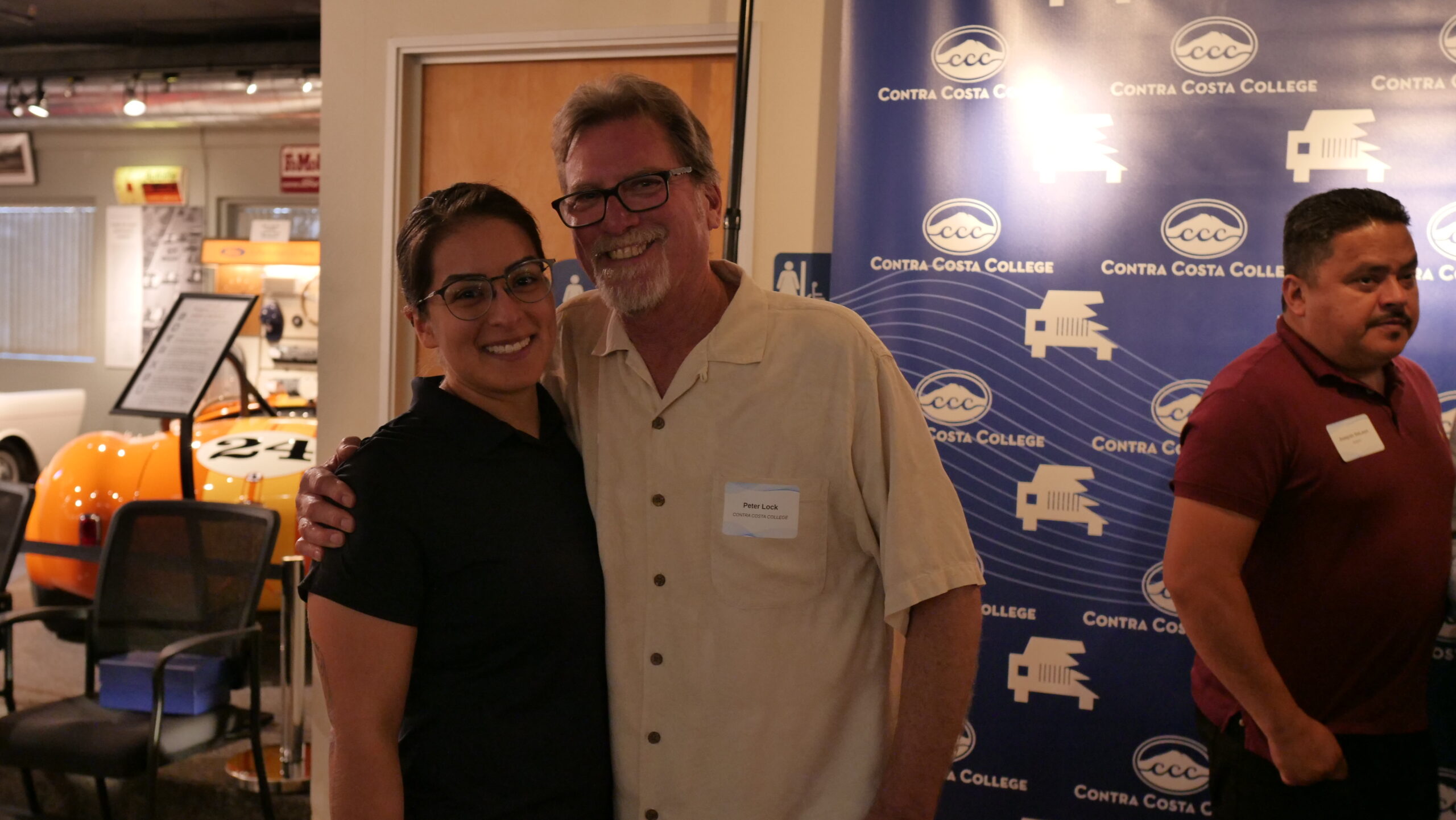
During this time, her mentor at Contra Costa College – Peter Lock – was preparing to retire. That moment prompted reflection on the future of the program and her own long-term goals. Laura had always imagined teaching someday…but not until much later in life. When Peter encouraged her to apply for an instructional role, it was initially framed as a learning exercise to understand the process.
What followed was a six-month hiring journey involving multiple interviews and steps. When the job offer finally arrived, it was unexpected. She hadn’t gone into the process expecting to be selected, but she was ready to take on the challenge. She committed fully, stepping away from the shop temporarily to focus on the opportunity. Her father supported the decision wholeheartedly, and she continued assisting with shop operations on weekends.
On her first day in the classroom, something immediately resonated. After teaching her first class, she knew this was what she wanted to do for the rest of her life. It felt like the right environment, the right energy and the right evolution of everything she had experienced before.
After that semester, Laura transitioned fully into education. Her father eventually made the decision to sell the shop. Since that day – a decade ago – she has remained in education, and it continues to resonate just as deeply as ever.
Today, she reflects on that journey as one built on adaptability, trust and continuous growth. Teaching collision repair keeps her connected to the industry that shaped her while challenging her in new ways every day. It continues to push her outside her comfort zone in ways that feel both meaningful and necessary.



Find out how Laura answered responded in her Q&A!
Read the rest on the Impact Report Newsletter Page (Subscribers Only).
Subscribe to Glossed & Gritty, and reserve your seat at the table!
*New window will open, return to this page and click Impact Report link below to access the Impact Report Subscriber Newsletter after subscribing.
Impact Report
Read more: The Riveter- May 2026Read Laura’s Q&A!!
[/swpm_protected]
Frame of Mind: Why I Am Done Being Complicit
I didn’t see the glass ceiling because I was too busy fighting the wall
By Jannifer Stimmel-Watkins, Technical Editor
If you knew how much the concept of “frame of mind” affects me from the bottom of my soul, you would probably be surprised. I have been in the collision industry for almost nine years, counting my time as a student. Throughout that time, I have been interviewed numerous times, and there is always that staple question:

For a long time, I never quite understood the question. I wanted everyone to know that I was just fine. I told interviewers the “struggle” was a myth. I often left those conversations feeling as if I had let them down by not sharing a hero’s saga about rising from the ashes like a phoenix.
The Blind Spot
It took Chas — my long-time friend, mentor, and now my business partner and co-founder — to gradually wear down my guard. It wasn’t the first time I’d been interviewed for an article, and it seems like, no matter how different the articles are, every journalist asks one question in common: “How does it feel to be a female technician in the collision industry?”
I never really understood why this kept coming up. I have always been proud of the fact that I was just fine, because I always had been, or so I thought. I went as far as to counteract the argument that women struggle in the collision industry. In my mind, the struggle was a myth. (But please don’t think that I’m callous; I have a high level of empathy, and it will make a lot more sense once y’all get to know me better. For now, I’ll focus on this story specifically.)
When I gave Chas my answer — that I was fine and that the struggles were overhyped — she didn’t accept that. She started questioning me further, and when I got defensive, she moved on to the next question. But she kept subtly coming back to the subject, sharing stories of the hurdles other women had faced. I was resistant and started making excuses for why they might have had those experiences. Chas was relentless though, and after going back and forth for over two hours, I started to recognize times that I HAD noticed sexism but had dismissed it. I felt nauseous. And then I got angry, not only at the system but also at myself.
After the call, I kept thinking about the conversation and as I realized that I had nearly started down the path of victim-blaming, my knee-jerk response shocked me; before entering this industry, I worked in healthcare with patients that could not access medications and care due to socioeconomic factors by day and with victims of sexual assault and domestic violence at night. Advocacy was close to my heart because of my own history, so I really started to evaluate why I struggled so much to see what was happening, and I realized that because I had spent my entire life proving that I WAS NOT a victim of ANYTHING, I allowed that mindset to bleed into my professional life. I refused to accept that hurdles were placed in front of me — which led to refusing to see them in front of anyone else.

The Unfair Advantage of a Combative Mind
My hard-headedness is more than a personality trait; it is a byproduct of my neurodivergence. Two years ago, I was diagnosed with autism. Growing up, it was engrained into my psyche that I simply had to work ten times harder than everyone else just to be accepted. I came to the understanding that it would forever be a part of who I am and that I could settle and have limitations…or I could overcome it and thrive. Of course, being the stubborn mule that I am, I embraced the latter.
I now realize my autism gave me an unfair advantage: I was often blind to the discrimination happening to me, and my natural combativeness made me thrive on the friction I did feel.
Because I often missed social cues and “hidden” barriers, I simply didn’t recognize when I was being sidelined. I didn’t accept “no” as an answer because I didn’t realize that “no” was meant to hold me back. More than that, I love challenges. I am naturally combative. If I felt someone pushing against me, I didn’t feel like a victim — I felt
like I was in a fight…and I intended to win. I still refuse to see myself as a victim. I control my destiny. Characterizing myself as a victim gives them control, and I refuse to allow someone else to determine my future — or the future of the women that come after me if I can help it.
While this helped me survive and fueled me even further, I cannot equate my struggle to the struggles of other women. They were aware of the weight being placed on them. They saw the “Keep Out” signs that I was blissfully unaware of. Because I didn’t recognize the discrimination, I had the advantage of not being throttled by it.
The Cost of Silence
I share this as an apology to these young ladies. I was complicit because I pushed them to be tougher, using my own combative survival as the benchmark. I didn’t see that I was asking them to ignore a reality that my own brain wasn’t even processing.
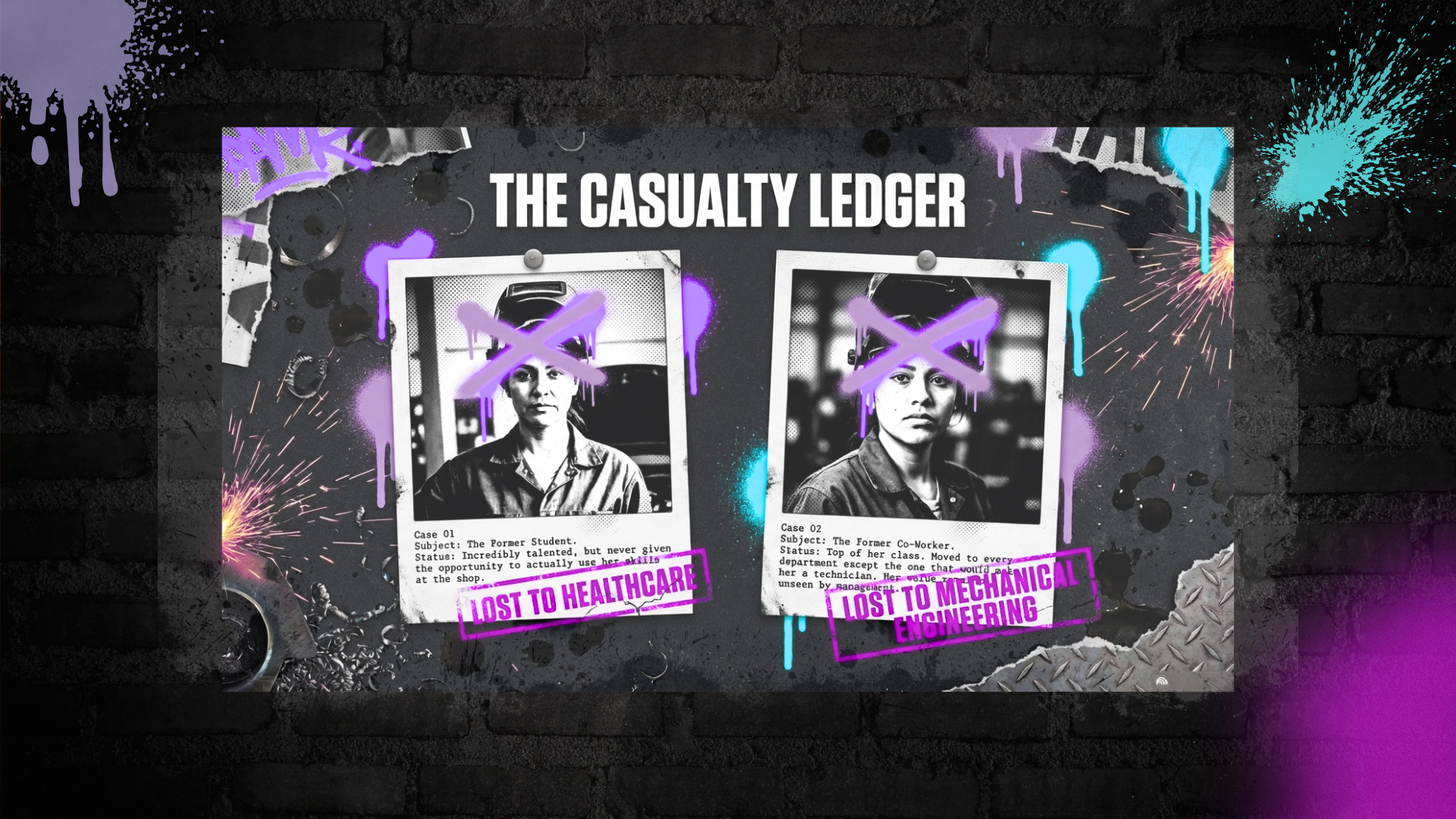
The cost of that silence is seen in the talented women who are no longer working by our side in the collision repair industry:
- The Former Student: I spoke to a female student of mine recently. She is incredibly talented, but at the shops where she worked, she was never given the opportunity to actually use her skills. She is now working in healthcare.
- The Former Co-worker: I worked with a woman who was at the top of her class, yet at our shop, she was moved to every department except the one that would make her a technician. Despite my efforts to speak on her behalf, her value remained unseen. She left for mechanical engineering and told me I needed to let go of her becoming a technician, just as she had.
I have pleaded with both of these women to return, but the damage was already done. I am upset with myself that I didn’t see it sooner. I was pushing them to crawl through mud that I didn’t even realize was there.
A New Mission: Changing the Space
I recently read a comment from Kristen Felder about how she enjoys “ruffling feathers” at the shop. I agree — it’s a sport to me, too. But she also mentioned that other women should not have to be as tough as she is, and that really resonated with me.
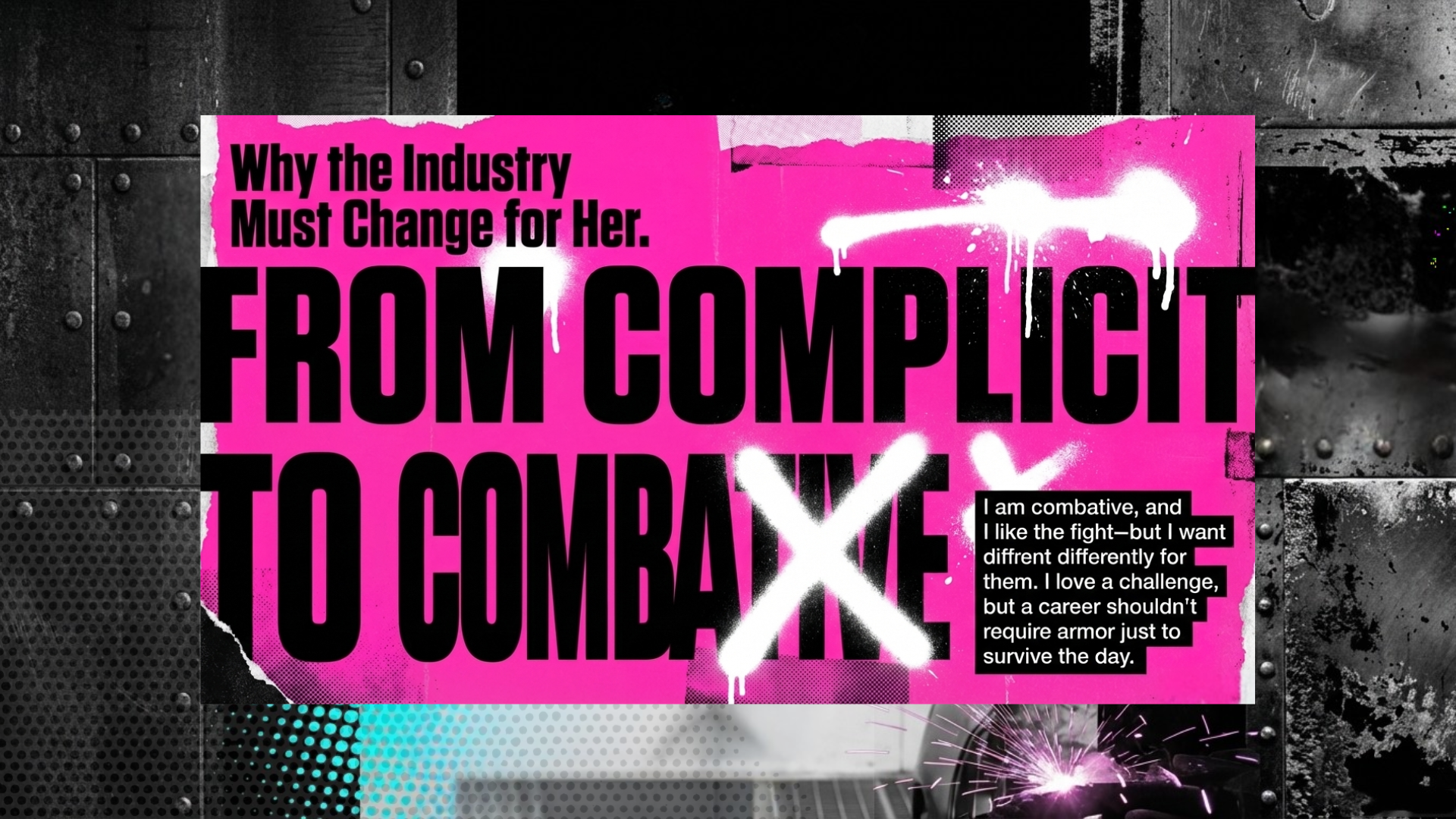
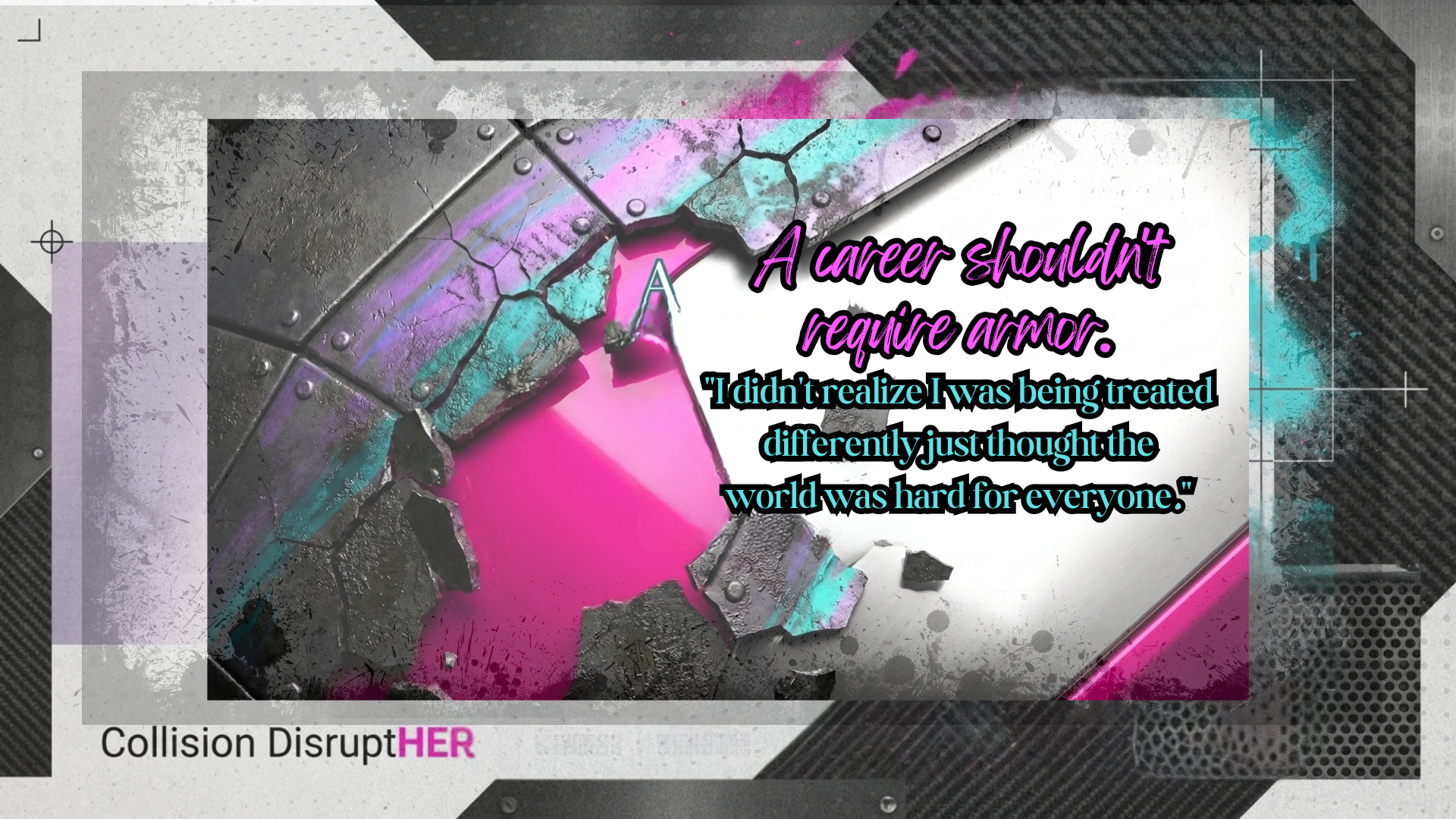
I am combative, and I like the fight — but I want differently for other women. A career shouldn’t require emotional armor beneath our PPE, just to survive the day.

Chas and I may have different views on how to approach the topic, but we both have the same end goal. Women deserve a place in this industry.
As an instructor for five years, I saw far too few female students graduate to the repair side. This is unacceptable. We have to stop accepting the way things are and change the industry to fit them rather than expecting them to fit into the industry. Those of us who are already here, who are already “tough,” should use that strength to change the space.
Through this magazine, we hope to give women a voice, greater visibility and a supportive community. We are dedicated to highlighting every achievement and advocating for growth. There is room for us in this space, and it is time we shared that with the newer generations.
Are you all with me? I am so excited about this journey, and I know that together, we can make a difference.
Because we are stronger together. And because less than 5% is not the end of the story — it’s the beginning.
We are the Collision DisruptHERs. And we’re just getting started.
Are VOCs More Toxic to Women?
In the collision industry, we obsess over “OE Specs.” We verify frame alignment to the millimeter and paint codes to the shade. Yet, we consistently ignore the most critical specification in the shop: the biological spec of the technician.
Working in the shop means exposure to various chemicals — we’re all exposed to potentially hazardous materials through the things we touch and the air we breathe. Paints, adhesives, fillers, solvents and even cleaning products emit VOCs (Volatile Organic Compounds) that are absorbed through the skin and inhaled into the lungs. Not exactly breaking news, of course… After all, that’s why safety protocols are broadcast, and wearing PPE (Personal Protective Equipment) is an accepted necessity.
But here’s the problem: those protocols meant to protect us are often developed based on standardized test models that do not represent the entire population. Historically, these studies were conducted in male-dominated industries and performed using “average adult body weights, which typically translates to around 175 pounds. This pattern is consistent across most industries, including PPE development, tools and even medical research. Why is this problematic? Well, for starters, women’s lower average body mass means that a similar airborne concentration equates to a higher dose per pound, so being exposed to identical concentrations could be more detrimental. But that’s not the only way that physiology factors into the discussion.
While safety protocols are often treated as “one size fits all,” we are NOT all the same size, and those differences aren’t solely about physical size; differences in metabolism, body fat percentage and hormonal cycles can all change how the body processes toxins. The reality of occupational toxicology proves that VOCs affect women’s bodies with a different — and often more dangerous — set of tolerances. And because safety standards weren’t designed for our biology, evidence suggests that women in the body shop could be at a greater risk of short-term and long-term effects due to VOC exposure. Emerging research demonstrates that sex-based physiological variances can influence how VOCs are absorbed, metabolized, distributed and eliminated.
So, let’s break it down.
Like the clear we lay, this Gloss has coats. You've only just begun to scuff the surface!
Already a member? Log in and keep reading.
Not in yet? Become a free member of the Collision DisruptHERs Community to unlock the next coat of Glossed access: more story, more context, and the parts we don't leave sitting on the surface.
Want the full article, complete issues, Impact Report, archives, and subscriber-only extras? That's the Gritty.


Beyond the Clear Coat: Heavy-Duty Pants for Heavy-Duty Repairs
By: Jannifer Stimmel-Watkins
In the collision industry, “Gloss” is the finished product, but the “Grit” is the repair. As technicians, our bodies are our most valuable tools. We spend our days contorting into trunk cavities, bracing against frame pulls and navigating a minefield of jagged metal and hot sparks.
If you’ve followed my column “Frame of Mind” or have seen my TikTok intro, you know my neurodivergence is part of my toolkit — but it comes with a catch. I was one of the “not-so-lucky” winners of the sensory sensitivity drawing. For someone like me, who often feels like every fiber of a garment is a restrictive harness, an article of clothing has to be more than just “tough;” it has to pass a rigorous set of qualifications just to prevent me from shredding it by the end of the day.
I have gathered a list of three specific pairs of pants on a budget tier from affordable to “you get what you pay for.” We all know that when we started out, flagging hours was never a guarantee — and when we did, it was at a reduced rate while apprenticing. But just like our tools, we eventually realize we must spend money to make money. That rule applies to our dresser drawers just as much as the drawers in our toolboxes.
I’ll admit my bias up front: I am a frugal little beaver, always stashing and building my dam, so I usually reside at the lower end of the budget regardless of the bank account; however, I know many choose to elevate the ensemble for reliability and durability. While I am a Dickies girl through and through, I polled a group of trusted technicians to see what else stood up to the grind.
Like the clear we lay, this Gloss has coats. You've only just begun to scuff the surface!
Already a member? Log in and keep reading.
Not in yet? Become a free member of the Collision DisruptHERs Community to unlock the next coat of Glossed access: more story, more context, and the parts we don't leave sitting on the surface.
Want the full article, complete issues, Impact Report, archives, and subscriber-only extras? That's the Gritty.